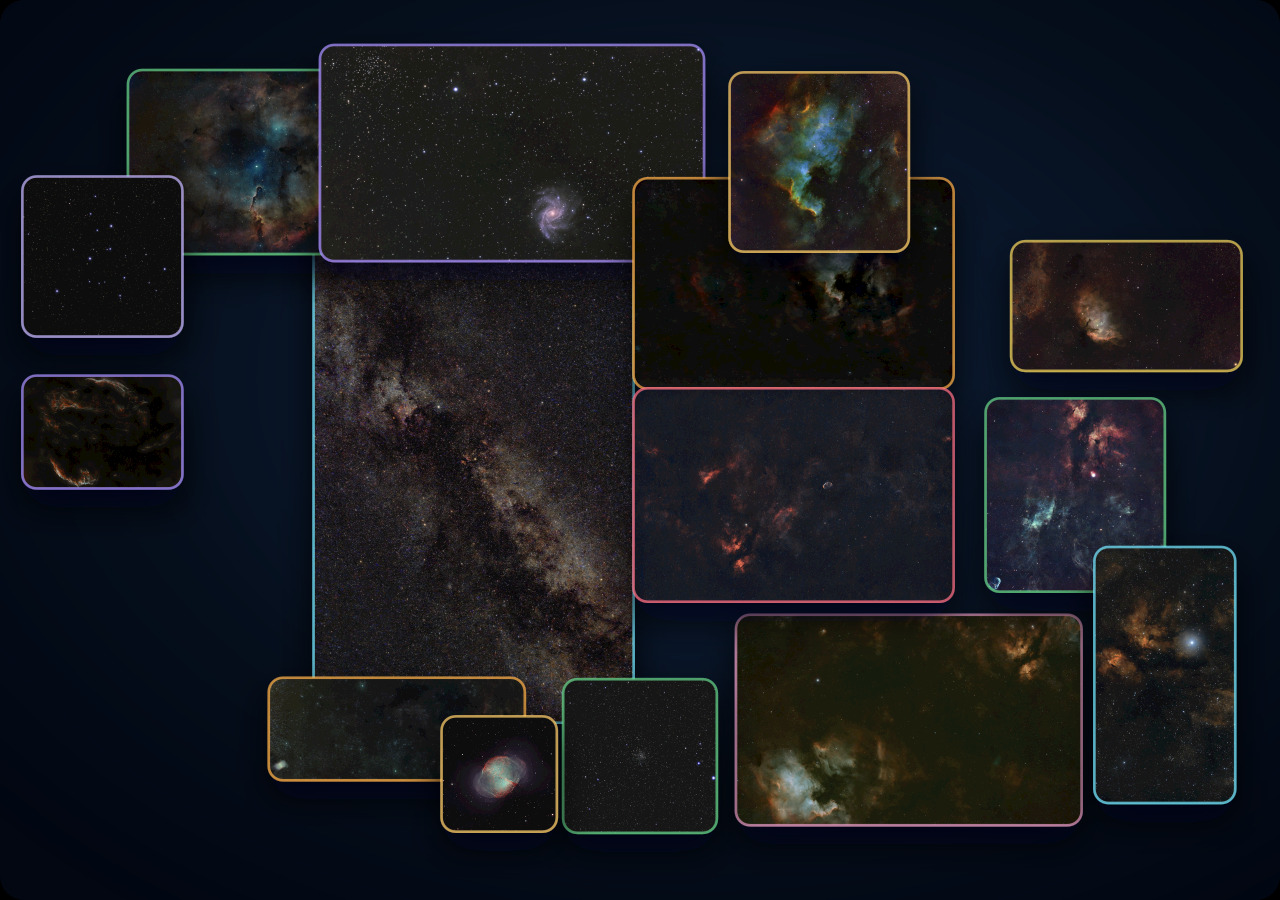
Cross the northern Milky Way from Cygnus down into Vulpecula, explore stellar nurseries, supernova debris, planetary nebulae, clusters, and a background galaxy.
15linked images
1root fields
4nested levels
Milky Way · Cygnus and Vulpecula · compact scale mapConfigured from Cygnus and Vulpecula survey.md
Registered scale map
Travel from sky region to target
14 of 14 transitions registered with WCS · branches mapped around the root
Cepheus Region
Fireworks Galaxy + NGC 6939
A foreground Milky Way cluster and a face-on spiral galaxy seen beyond the northern Galactic plane.
Cepheus Region
Elephant's Trunk Nebula
The dark globule IC 1396A silhouetted within a much larger ionized cloud near the Cepheus edge of the root field.
Veil Nebula / Cygnus Loop
Veil Nebula · 8 hours
The western arc of the Cygnus Loop traces an expanding shock front from a supernova thousands of years ago.
Broader Sadr Region
M39 · Pyramid Cluster
A nearby, sparse open cluster projected against the dense northern Cygnus star field.
MilkyWay Cygnus vulpecula
Milky Way · Cygnus and Vulpecula
A two-hour S30 Pro Milky Way-mode field spanning the Cygnus Rift, the rich Cygnus star clouds, and Vulpecula to the south.
Dumbbell Nebula Vulpecula Region
M27 · NGC 6830 · NGC 6823
A 15-hour regional field spanning the Dumbbell Nebula and the NGC 6830 and NGC 6823 clusters across Vulpecula.
Dumbbell Nebula
Dumbbell Nebula
M27 is the expanding ionized envelope shed by a dying Sun-like star in Vulpecula.
Angelfish Cluster
M71 · Angelfish Cluster
A relatively metal-rich globular cluster seen through the star fields of Sagitta near the Vulpecula edge.
Broader Sadr Region
North America · Pelican · Butterfly
A six-hour field bridging North America and Pelican to Butterfly. The two regional branches overlap this view and extend beyond its edges.
Broader Sadr Region
NGC 7000 + IC 5070
A tighter view of the ionization fronts and dark lanes shared by the North America and Pelican nebulae.
Broader Sadr Region
North America · Pelican · Clamshell
An overlapping North America and Pelican field extending beyond the intermediate view toward the Clamshell Nebula.
Broader Sadr Region
Crescent + Sadr region
An overlapping Sadr field extending beyond the intermediate view toward the Crescent Nebula.
Broader Sadr Region
Butterfly + Crescent
A combined field spanning IC 1318's divided emission clouds and the wind-blown Crescent Nebula.
Broader Sadr Region
Butterfly Nebula + M29
IC 1318's divided emission clouds share the field with the young Cooling Tower Cluster.
Broader Sadr Region
Tulip Nebula
Sh2-101 is an H II region excited by hot young stars along the same crowded Cygnus sightline.
Across the northern Milky Way
This field crosses one of the most structurally varied parts of the northern Galactic plane. Dark clouds of the Cygnus Rift obscure the more distant stellar background, while nearby and distant emission regions mark separate episodes of massive-star formation. The same wide view also contains the debris of stellar death, exposed star clusters, and—through a comparatively transparent line of sight—the Fireworks Galaxy far beyond the Milky Way.
Cygnus star formation: The North America–Pelican complex, the Sadr region, the Crescent Nebula, and the Tulip Nebula show different ways ultraviolet radiation and stellar winds ionize, compress, and excavate interstellar gas.
Stellar endpoints: The Veil is a supernova remnant produced by a massive star, while the Dumbbell is a planetary nebula formed when a lower-mass star expelled its outer layers.
Stellar populations and depth: M39 and M29 are young open clusters in the Galactic disk; M71 is an old globular cluster. NGC 6939 is paired in projection with NGC 6946, a spiral galaxy millions of light-years beyond every Milky Way object in the map.
 AstroGuide:Portfolio Chris Hollander’s Astrophotography