A public reference for Chris Hollander's current backyard astrophotography setup, organized around an interoperable construction kit of hardware, power, accessories, deployment practices, and experimental rig profiles used around regular capture sessions.
Some product links on this page may earn referral credit. As an Amazon Associate I earn from qualifying purchases.
7matrix rigs
4operational rigs
91inventory rows
1commissioning rigs
Core setup
Capture baseline and experiments
This page is a compact equipment and deployment reference for the astrophotography setup. It treats the
gear as a construction kit: shared mounts, optics, cameras, filters, and control hardware can assemble into
rigs with very different imaging capabilities.
OperationalS50, S30 Pro, WiNG, and F30 are available for regular capture
In RepairWideSky is unavailable while repairs are underway
Commissioningassembling core components and working towards first light
Alternatessuccessfully operated, components currently in use in other operational rigs
Imaging ecosystem
Imaging Ecosystem
Seven imaging rigs assembled from a shared collection of smart scopes, optics, cameras, mounts, and control hardware—each with a different role in the capture lineup.
Group
Rig
Main components
Description
Status
Next steps
Survey InstrumentsThese are used to evaluate subjects for deeper imaging projects; they perform initial data collection for test framing, filter response, and sky brightness impact.
At a modest 250 mm focal length, this is my longer-reach device until the Celestron-based rigs are operational. It is used primarily for galaxies, detail regions, and smaller nebulae.
Operational
Continue as the primary longer-reach rig while the Celestron systems move toward operational status.
The best astro-specific sensor I have right now, paired with a useful wide field of view. It is used primarily for larger nebulae, often narrowband subjects.
Operational
Continue as the wide-field and narrowband workhorse for larger nebulae.
Specialized Integration InstrumentsThese are used for longer integration for planned projects; they have specialized roles such as wide field, narrowband, and long focal length.
My sharpest optics paired with my largest sensor, optimized for very wide fields. The astro-modified Nikon D5300 / FMA135 system is currently in repair.
In Repair
Complete repairs before returning to wide-field capture; its previous ASI178MM guide camera is now used by WiNG.
WiNG stands for Williams-Optics: Interstellar, Nebula and Galaxies. The 61 mm, 360 mm refractor now uses an ASI178MM monochrome camera, an eight-position filter wheel, and electronic autofocus. ASI662MC guiding supports longer integrations on nebulae, galaxies, and detail fields.
Operational
Continue building integration on smaller nebulae, galaxies, and detail fields while refining the repeatable swap between WiNG and F30 on the EQ-AL55i platform.
A compact combination using what is often a guide camera as the primary camera. Its field of view is similar to the Seestar S30—thus the name—but at lower resolution.
Operational
Continue capture with the operational ASI662MC / ASI224MC setup under ASIAIR Mini control and document its shared EQ-AL55i deployment.
PiNG stands for Planetary, iNterGalactic. The Celestron C6 and 0.63x Reducer/Corrector provide a nominal 945 mm focal length at f/6.3, paired with the ASI662MC for compact subjects. ASIAIR Mini controls the rig, with ZWO EAF focusing and the same SV165 / ASI224MC guide configuration as F30. The rig remains in commissioning.
Commissioning
Complete assembly of the core components and work towards first light.
DecommissionedThese rigs were assembled and proven operational, but their components are currently being used in other operational rigs.
My longest focal length paired with my largest sensor. C50 keeps its original name, now using the 6-inch C6 at 1500 mm for a narrower field than the S50. First light was captured with the previous 5SE OTA.
Alternates
Reassemble when needed as an alternate; components are currently in use in other operational rigs.
Capability matrix
Component-level comparison of the seven rigs, including optics, control, field of view, and operational state.
1.18 x 0.79Diagonal: 1.42Calculated for the ASI178MM at 360 mm. The example below shows the earlier ASI662 framing.
2.36 x 1.33Diagonal: 2.71
9.95 x 6.61Diagonal: 11.93
0.34 x 0.19Nominal ASI662MC field at 945 mm: approximately 20.3 x 11.4 arcminutes. Actual reduction depends on reducer-to-sensor spacing.Diagonal: 0.39
Previous PiNG guiding configuration with the ZWO OAG; retained as available equipment
Not tagged yet
Filters
All owned Seestar filters work with either Seestar telescope and can also be used through the SVBONY filter drawer or ICE step-up ring where the optical path supports it.
Quick-release ratcheting handles provide clearance when Vixen rail clamp knobs would otherwise collide with flat-bottom devices such as the Seestar telescopes
Rechargeable 500-lumen headlamp for field setup and teardown
USB Ecosystem Adapters
These adapters help the four-port USB and four-port 12 V ASIAIR system use standard cables for both data and power. Voltage, polarity, connector dimensions, protocol, and load requirements are verified before a 12 V adapter is introduced into a device path.
Allows reliable, correctly sized USB-C cables to replace rigid or inconvenient dedicated 12 V leads where the equipment's electrical requirements match
Provides a right-angle magnetic breakaway for power and data; matching cables remain in the field and office so telescopes can move between them quickly
General-purpose adapters used in both directions across field and office cabling
Cable Management
Stable, quasi-permanent cable runs reduce setup mistakes and the risk of a snag damaging a camera, telescope, mount, or connector. Appropriate cable lengths and the USB adapter system keep each bundle as short and legible as possible.
Controlled heat source used to finish the heat-shrink ends of permanent cable bundles
Outdoor Power Weatherproofing
Permanent outdoor power requires layered weather protection: enclosed supplies and connections during operation, plus separate covers for cable ends and plugs when they are idle.
Covers plugs emerging from the weatherproof boxes whenever they are not connected
iPhone Accessories
The iPhone can act as a primary capture device or an operational instrument. Current uses include cloud timelapses that can be correlated with image-quality and weather data, plus 360-degree panoramas of observing sites.
Power, data, and control paths across the Seestar and ASIAIR-driven capture systems.
Earlier backyard power and data wiring
Reference wiring before WideSky entered repair and the WiNG/F30 camera reassignment. WiNG now uses ASI178MM imaging, ASI662MC guiding, ZWO EFW, and ZWO EAF; F30 uses ASI662MC imaging and ASI224MC guiding. Updated accessory cabling is not shown here.
External AC power
12 V power
USB power cables
USB-A → USB-B / USB-C / EQMOD (data)
USB-A → Mini-USB
Operational notes
Current field practice
WiNG uses ASIAIR Pro; F30 and PiNG use ASIAIR Mini. WideSky, currently in repair, also has an ASIAIR Mini configuration. Controller assignments follow each rig configuration, even when mounts are shared.
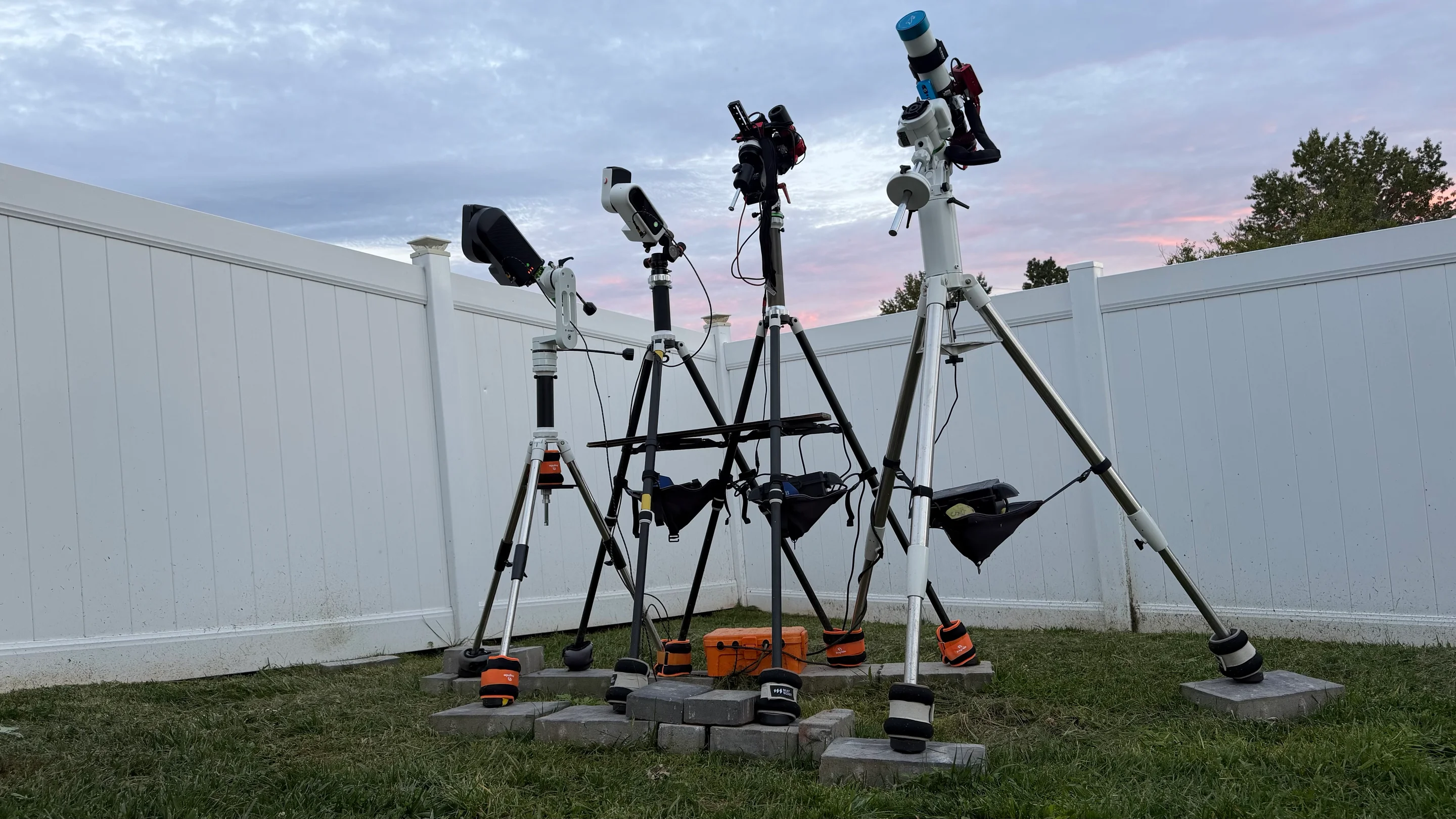
The center shelf shown in the reference photo is a temporary plank of wood, not a formal part of the documented rig.
The pavers are fixed parts of the current backyard setup and serve as semi-permanent footing / leveling support until replaced by something more permanent.
The green laser pointer is not part of every observing session and is not in use by default.
WideSky is in repair; its previous ASI178MM guide camera is now used as the WiNG main camera.
C50 is an alternate: successfully operated, components currently in use in other operational rigs.
PiNG is commissioning with the C6 / Celestron 0.63x Reducer/Corrector / ASI662MC imaging train, ASIAIR Mini control, ZWO EAF, and SV165 / ASI224MC guiding.
The older NexStar 5SE / D5300 setup is retained as a shared-parts reference, but C50 is the current matrix column for the replacement Celestron C6 / Nikon D5300 configuration.
The backyard setup is quasi-permanent: the two main tripods stay outside 24/7, while the telescopes are brought in and out.
Both Seestar scopes normally run on external power for the full session.
The Astromania 30 mm f/4 Mini Guide Scope was returned and is decommissioned: difficulties reaching acceptable focus for guiding, compared to SV165. The two SV165 scopes support WiNG and the F30/PiNG guiding configurations while WideSky is in repair.
Setup assumptions
Reusable assumptions
The capability matrix status row is the source of truth: S50, S30 Pro, WiNG, and F30 are operational; WideSky is in repair; PiNG is commissioning; C50 is an alternate.
S50 uses the SVBONY SV225 alt/az mount as its EQ wedge on the SVBONY SV225T tripod.
WiNG uses ASIAIR Pro; F30 and PiNG use ASIAIR Mini. Confirm final 12V distribution, camera and mount power, and cabling details for these configurations and the WideSky/C50 alternatives.
C50 alternate deploymentOn demand
Successfully operated; reassemble when components are available from other operational rigs
WiNG uses SV165 / ASI662MC guiding; F30 and PiNG use SV165 / ASI224MC. WideSky is in repair and its previous ASI178MM guide camera is now on WiNG. C50 remains an alternate with shared guiding hardware.
F30 field documentationIn progress
F30 is operational with ASI662MC imaging and ASI224MC guiding under ASIAIR Mini control on the shared EQ-AL55i Pro platform; finish power and cabling field notes.
PiNG commissioning checklistCommissioning
PiNG uses the C6 with Celestron 0.63x Reducer/Corrector, NexStar SE tripod and NexStar+ GoTo mount, SVBONY SV241, ASIAIR Mini, SV165 / ASI224MC guiding, ZWO EAF, and Celestron dew heater ring. Confirm reducer-to-sensor spacing and final cabling during commissioning.
Celestron C6 camera adapter stackNeeds confirmation
Useful for documenting the exact D5300 and ASI662 connection and spacing
Dew shield / mask / spike accessory fit mapNeeds confirmation