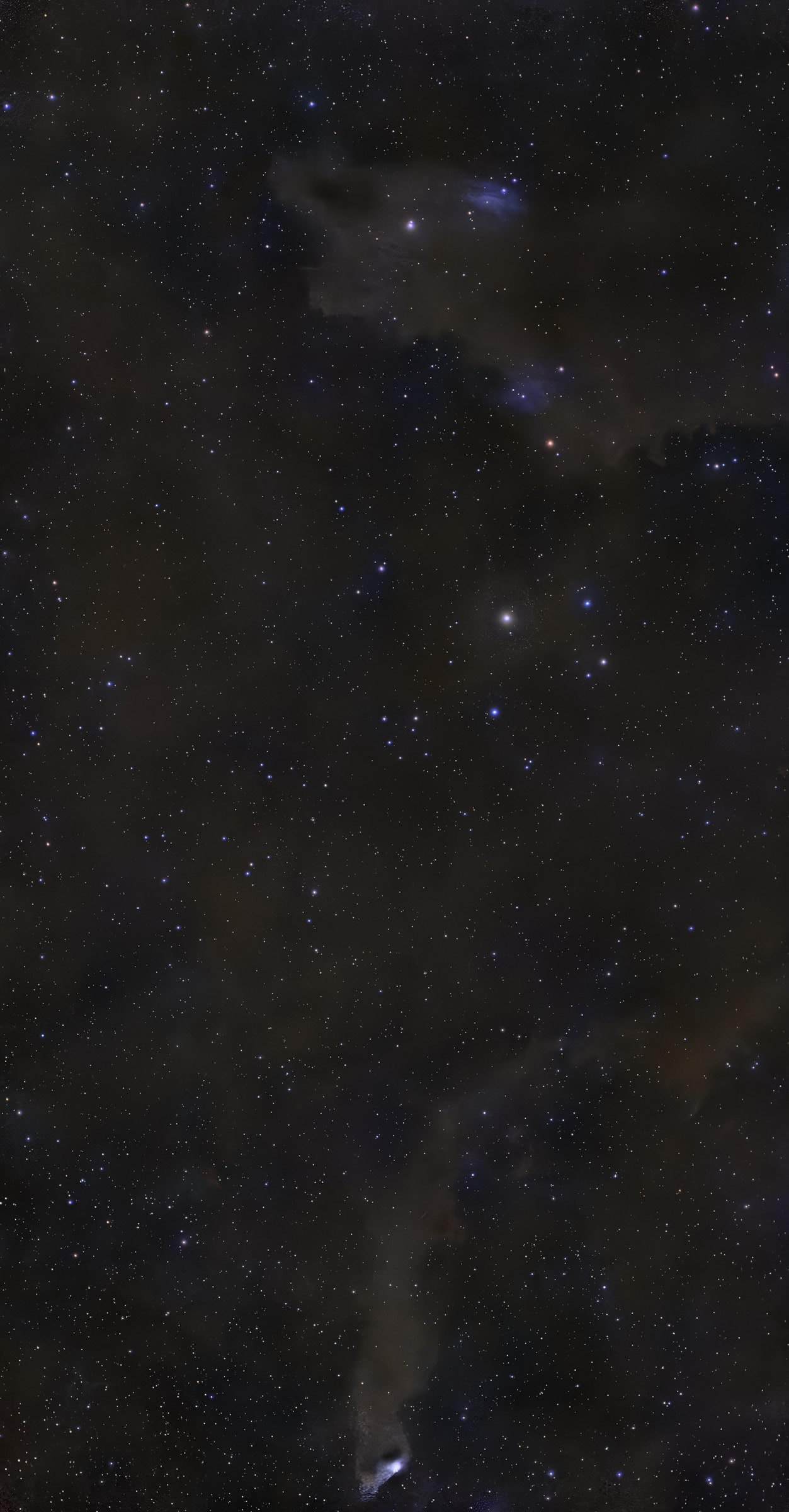
Story
The Fine Line Between Dust and Noise
The Dark Shark and Wolf’s Cave turn a six-and-a-half-hour integration into a study of faint dust, reflected starlight, and processing restraint.
I’ve been struggling lately with processing dark nebulae and interstellar dust. So naturally, I decided the solution was to capture two notoriously difficult ones at the same time. 😂
A field defined by missing light
Dark nebulae are fundamentally different from the bright emission nebulae I usually photograph. Most of this dust doesn’t glow. We see it because it blocks the dense field of stars behind it, or because nearby stars illuminate portions of the cloud as faint reflection nebulae.
That makes processing incredibly delicate: push too little and the dust disappears. Push too hard and gradients and noise can start masquerading as structure.
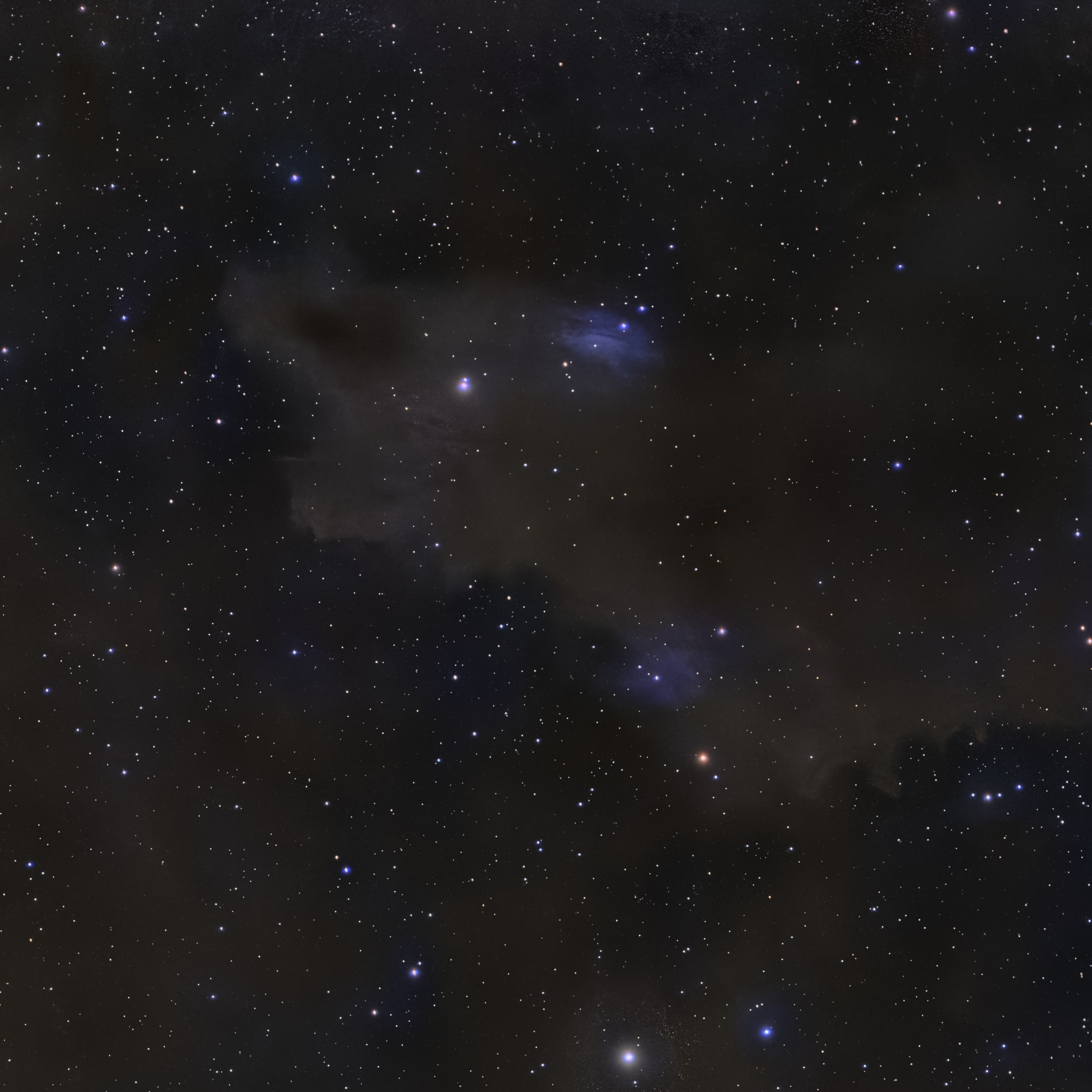
At the top of this field is LDN 1235, the Dark Shark Nebula, one of the more notoriously difficult broadband targets to capture and process. Unlike a bright emission nebula, there isn’t a strong glowing signal to isolate. You’re trying to tease extremely subtle differences in brightness and color out of faint dust illuminated by the surrounding star field—without turning gradients, noise, or processing artifacts into “nebulosity.”
Following the dust
Follow the dust downward and the field eventually reaches LDN 1217, a long dark cloud terminating in the tiny bluish-white reflection nebula GN 23.56.2, the Wolf’s Cave Nebula.
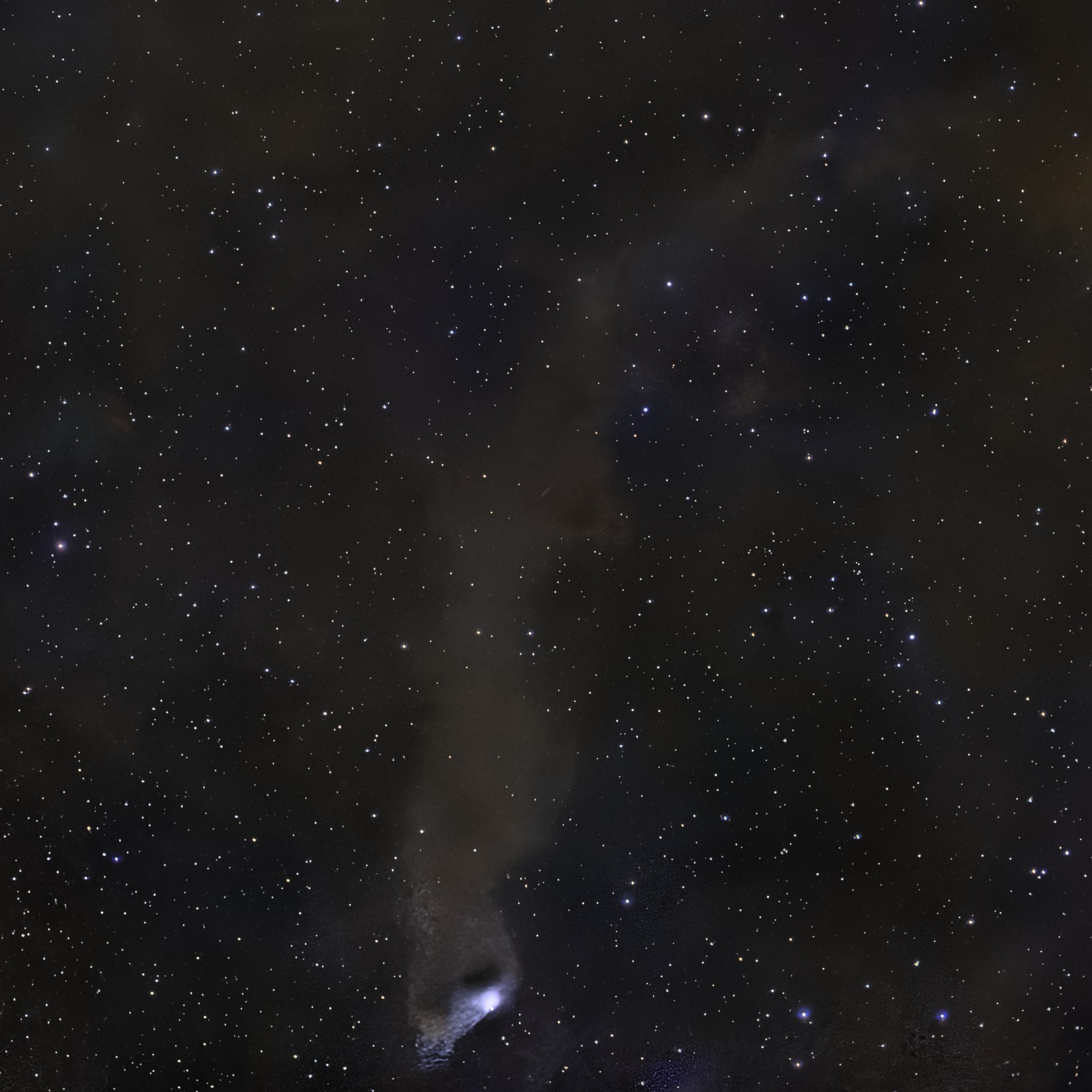
The two regions reveal dust in complementary ways. Across much of the frame, the cloud is visible only through the starlight it dims and reddens. At Wolf’s Cave, a small patch of reflected light makes the dust easier to recognize directly.
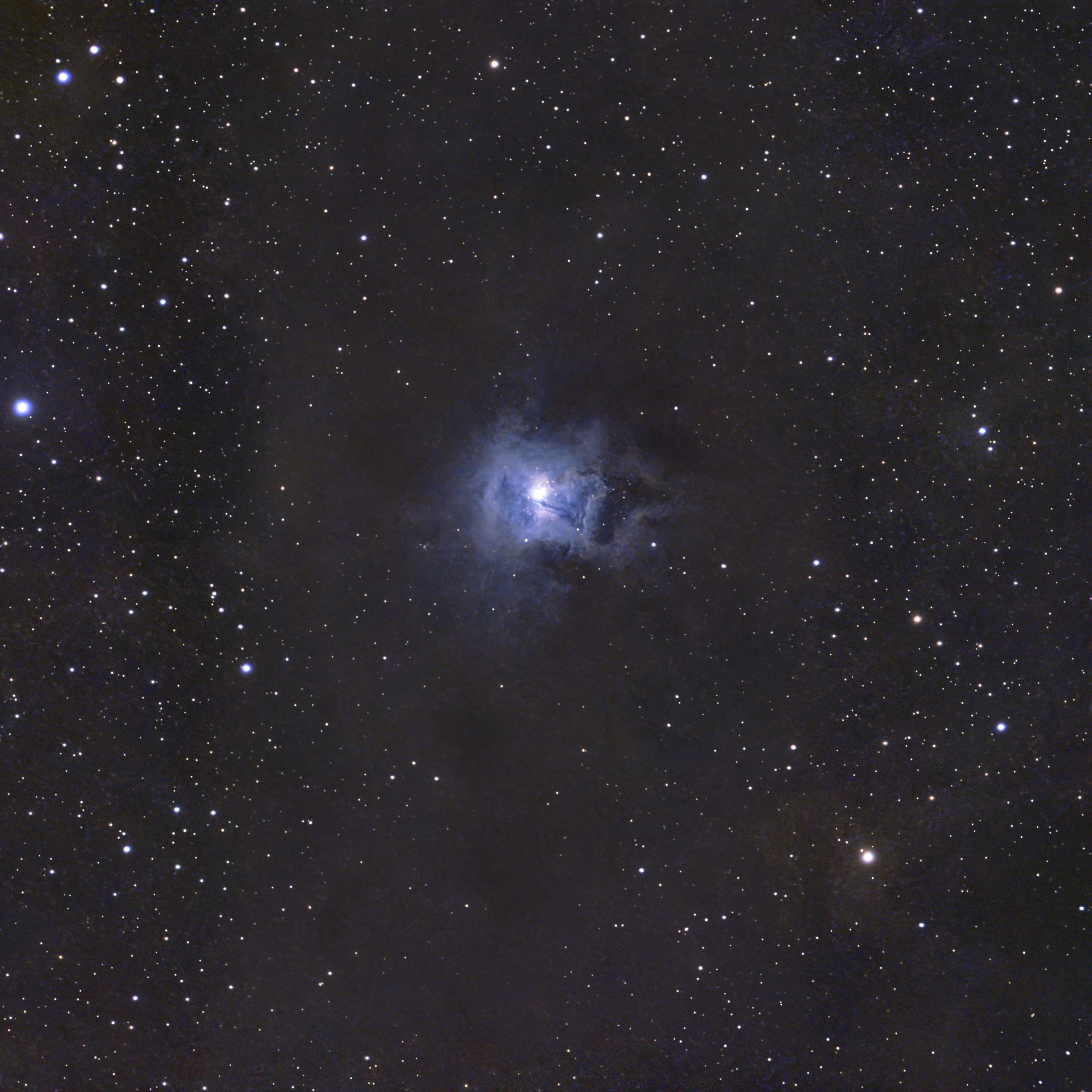
The Iris Nebula is a useful counterpoint. Its luminous reflection core gives the eye a clear anchor, while the Dark Shark field asks you to recognize much subtler changes spread across a crowded background.
A first pass at a demanding field
I collected roughly 10 hours across two sessions with the Seestar S30 Pro in EQ mode, then rejected frames affected by tracking, gradients, clouds, and other problems. About 6.5 hours remained in the final integration.
For a target this faint, that is a starting point rather than an especially deep exposure. Dark Shark projects can accumulate dozens of hours of data; this first integration is enough to begin tracing the field and, just as importantly, to learn where the data stops supporting the processing.
Processing this was an exercise in restraint. With emission nebulae, I’m often trying to reveal signal. With a field like this, the challenge is deciding whether the incredibly faint structure I’m revealing is actually dust—or something I accidentally created during processing.
The most dangerous artifacts are also the most plausible ones. A broad gradient can resemble diffuse dust. Chromatic noise can mimic reflected color. Local contrast can make a real boundary look more certain than the data supports. Every adjustment becomes a judgment about how much structure the observation can honestly carry.
Learning to trust the absence
I’m still learning that balance, but this is easily my best result on a dark-nebula field so far.
And apparently my strategy for getting better at difficult subjects is just to make them more difficult. 😅
Technical notes
Acquisition
- Location: My New Jersey backyard, approximately Bortle 4–5.
- Capture system: Seestar S30 Pro in EQ mode.
- September 5: Approximately 600 × 30-second subframes.
- September 6: Approximately 300 × 60-second subframes.
- Final integration: About 6.5 hours after rejecting frames affected by tracking, gradients, clouds, and other problems.
Post-processing workflow
- GraXpert background extraction.
- SPCC color calibration.
- Initial BlurXTerminator and NoiseXTerminator passes.
- StarXTerminator star separation.
- Light SCUNet denoising with the PSNR model.
- Manual GHST stretching.
- VeraLux curves.
- Star recombination, with separate stretch adjustments for the stars and background.
- BlurXTerminator applied for star sharpening only.
- Nonlinear SCUNet denoising with the Color 25 model.
- A final nonstellar BlurXTerminator pass.