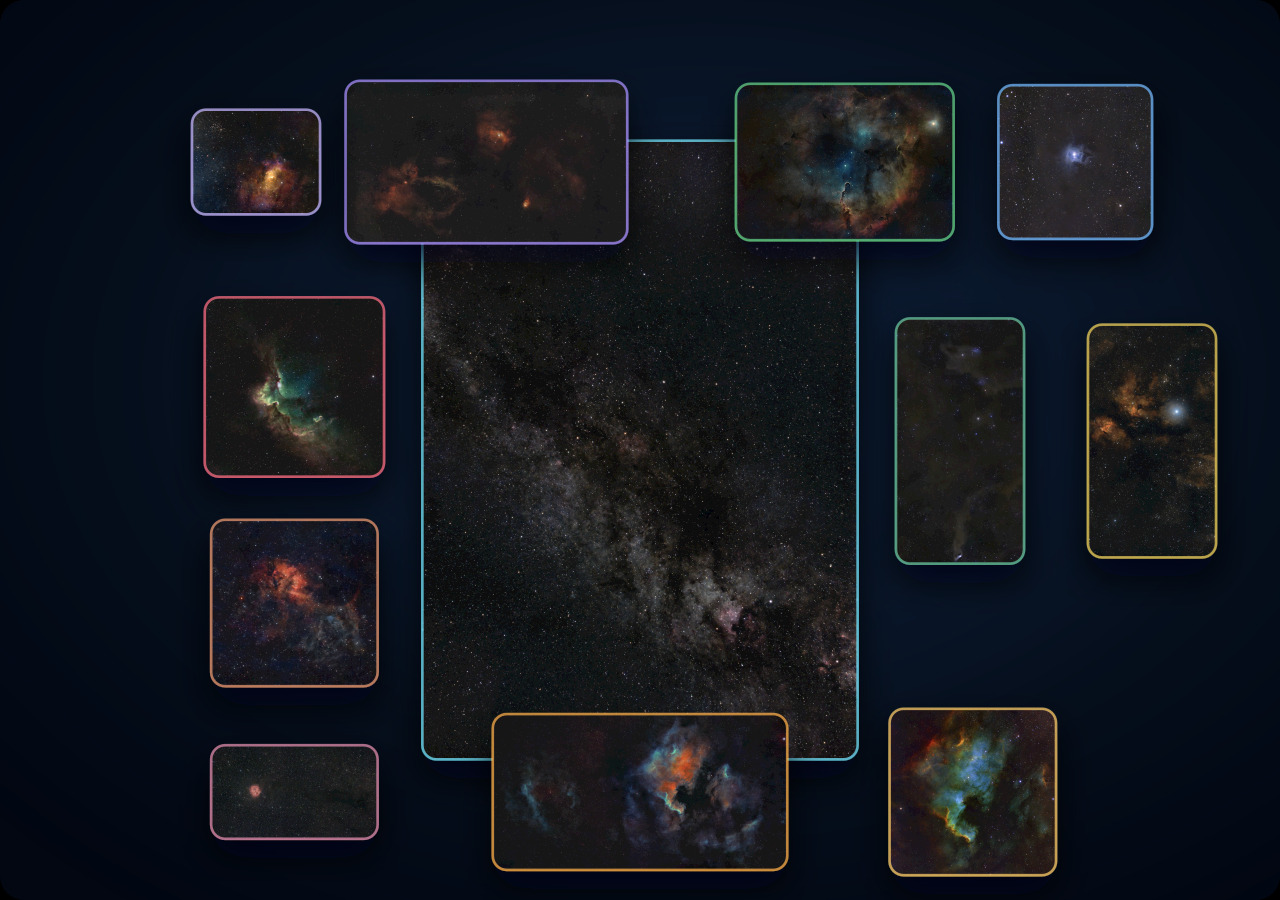
Trace the northern Milky Way into ionized nebulae, dark molecular clouds, young clusters, and wind-blown structures across Cepheus and Cygnus.
12linked images
1root fields
3nested levels
Milky Way · Cepheus and Cygnus · compact scale mapConfigured from Cepheus and Cygnus Survey.md
Registered scale map
Travel from sky region to target
11 of 11 transitions registered with WCS · branches mapped around the root
Cepheus Region
Bubble Nebula
NGC 7635 isolated at a much tighter scale.
Cepheus Region
Lobster Claw + Bubble region
An 11-hour field spanning Sh2-157, the Bubble Nebula, Northern Lagoon (NGC 7538), and M52.
Cepheus Region
Elephant's Trunk Nebula
IC 1396 and the Elephant's Trunk emerging from the same wide Cepheus field.
Cepheus Reflection
NGC 7023 · Iris Nebula
A reflection nebula where the light of a young star illuminates and scatters through a surrounding cloud of interstellar dust.
Cepheus Region
Wizard Nebula
NGC 7380 isolated in a 13-hour SHO study within the wider Cepheus field.
Cepheus Region
Sh2-132 · Lion Nebula
A six-hour view of the Lion Nebula within the wide Cepheus field.
milkyway cepheus and cygnus
Milky Way · Cepheus and Cygnus
A very wide field spanning the emission-rich Cepheus and Cygnus neighborhoods.
Broader Sadr Region
IC 5146 · Cocoon Nebula
A 150-minute view of the Cocoon Nebula in Cygnus, fully contained within this survey field.
Broader Sadr Region
Clamshell · North America · Pelican · Forsaken
The broad North America and Pelican complex, including the surrounding Clamshell and Forsaken structures.
Broader Sadr Region
NGC 7000 + IC 5070
A tighter study of the North America and Pelican nebulae.
Cepheus Reflection
Dark Shark + Wolf's Cave
LDN 1235 and LDN 1217 trace a long northern lane of absorbing and reflecting interstellar dust.
Broader Sadr Region
Butterfly Nebula + Cooling Tower Cluster
IC 1318 and M29 resolve into a denser two-hour field beneath the wider Cygnus view.
A corridor of stellar nurseries
The Cepheus–Cygnus segment of the northern Milky Way is a layered view through molecular clouds, ionized hydrogen, dark dust lanes, and young stellar populations. The glowing structures are not one continuous nebula at one distance: they are separate star-forming complexes projected into the same exceptionally rich line of sight. Moving inward through the map reveals several ways massive stars reshape their birth clouds—ionizing gas, excavating cavities with stellar winds, compressing dense globules, and exposing newly formed clusters.
Lobster Claw, Bubble, and M52: Sh2-157 is an H II region sculpted by radiation from massive stars, while NGC 7635 is a wind-blown shell around an exceptionally energetic star. The young open cluster M52 appears in the same crowded Cepheus field.
Elephant’s Trunk and IC 1396: IC 1396A is a dense, elongated globule embedded in a much larger emission nebula. Radiation and winds erode and compress its rim, while obscured protostars form inside the surviving cloud.
Iris Nebula: NGC 7023 is a reflection nebula: dust surrounding the young star HD 200775 scatters its blue-white light while denser material forms the dark molecular cloud around it. The illuminated cavity provides a contrasting view of star formation without the strong line emission that defines the neighboring H II regions.
North America and Pelican complex: NGC 7000 and IC 5070 are neighboring illuminated portions of the same broad star-forming cloud. Foreground dust divides the emission into the familiar continental and pelican-shaped outlines and marks active interfaces between molecular material and ionized gas.
Lion Nebula: This six-hour Sh2-132 result adds another detailed Cepheus field beneath the same wide Milky Way root.
Cocoon Nebula: The 150-minute IC 5146 result adds a compact Cygnus target whose complete image footprint fits inside this survey root.
Wizard Nebula: The young open cluster NGC 7380 supplies the ultraviolet radiation that excites the surrounding Sh2-142 nebula. Pillars, ridges, and cavities record the interaction between the cluster’s massive stars and their natal material.
Dark Shark and Wolf’s Cave: LDN 1235 and LDN 1217 are cold, dusty clouds seen primarily through the starlight they absorb, redden, and scatter. At the end of the complex, the compact reflection nebula GN 23.56.2 provides a small luminous marker within the otherwise dark structure.
Butterfly Nebula and M29: IC 1318 is a large emission complex crossed by prominent dark lanes near the apparent position of Sadr. M29 is a compact young open cluster projected into this dense Cygnus star field, adding a stellar-population view alongside the surrounding gas structures.
The nesting in this visualization represents angular coverage on the sky; objects that share a frame are not necessarily at the same physical distance or part of the same cloud complex.
 AstroGuide:Portfolio Chris Hollander’s Astrophotography