Transient study
A Nova Erupts in Andromeda
A 25-hour portrait of our nearest major galactic neighbor became a before-and-after record of AT 2026aabo erupting within Andromeda.
Photographing our galactic neighbor
Like many astronomers and astrophotographers, I had been collecting data on Andromeda for the simplest of reasons: it is beautiful. It is also our nearest major galactic neighbor—a spiral galaxy close enough to stretch across several full-Moon widths in our sky, yet distant enough that its light takes roughly 2.5 million years to reach us.
The Milky Way and Andromeda are the two great spirals of the Local Group, the collection of galaxies that forms our immediate cosmic neighborhood. The Triangulum Galaxy, M33, is its third-largest member, while many smaller galaxies orbit or move among the larger systems. In this portrait, two of Andromeda’s own companions are plainly visible: compact M32 near the bright disk and the more diffuse M110 beyond it.
Between late April and early September, I returned to M31 again and again, accumulating nineteen imaging sessions across changing conditions, exposure lengths, and filters. My familiar goal was to gather enough light to bring out Andromeda’s dark dust lanes, blue star-forming regions, and the soft outer reach of its disk.
For months—despite different instruments, changing sky conditions, and Andromeda’s changing position in the sky—the galaxy itself remained constant; then, in the last few weeks of this project, something in it actually changed.
Near the northeastern side of the galaxy, a star-like source appeared where my earlier images showed nothing. It is AT 2026aabo, a bright nova in the Andromeda Galaxy. Because I had already photographed the same field for months, I did not just have an image of the outburst. I had the before image waiting in my archive.
At M31’s distance, the light recorded here began traveling toward Earth roughly 2.5 million years ago. The outburst is recent only in the sense that its light has just reached us.
A new point inside a familiar galaxy
M31 is one of the most recognizable objects in the northern sky. In a wide image its luminous core dominates, crossed by layered dust lanes and surrounded by an enormous disk of unresolved stars. Its two prominent satellite galaxies, M32 and M110, sit nearby in projection. From our position inside the Milky Way, Andromeda also gives us something we can never quite have at home: an exterior view of a large spiral galaxy in our own neighborhood.
AT 2026aabo is nowhere near the bright nucleus. It lies far out in the apparent disk, in a region where the galaxy’s glow is faint and the surrounding field is crowded with foreground Milky Way stars. Without an annotation—or a previous image—it is remarkably easy to overlook. It looks like just one more small blue-white point.
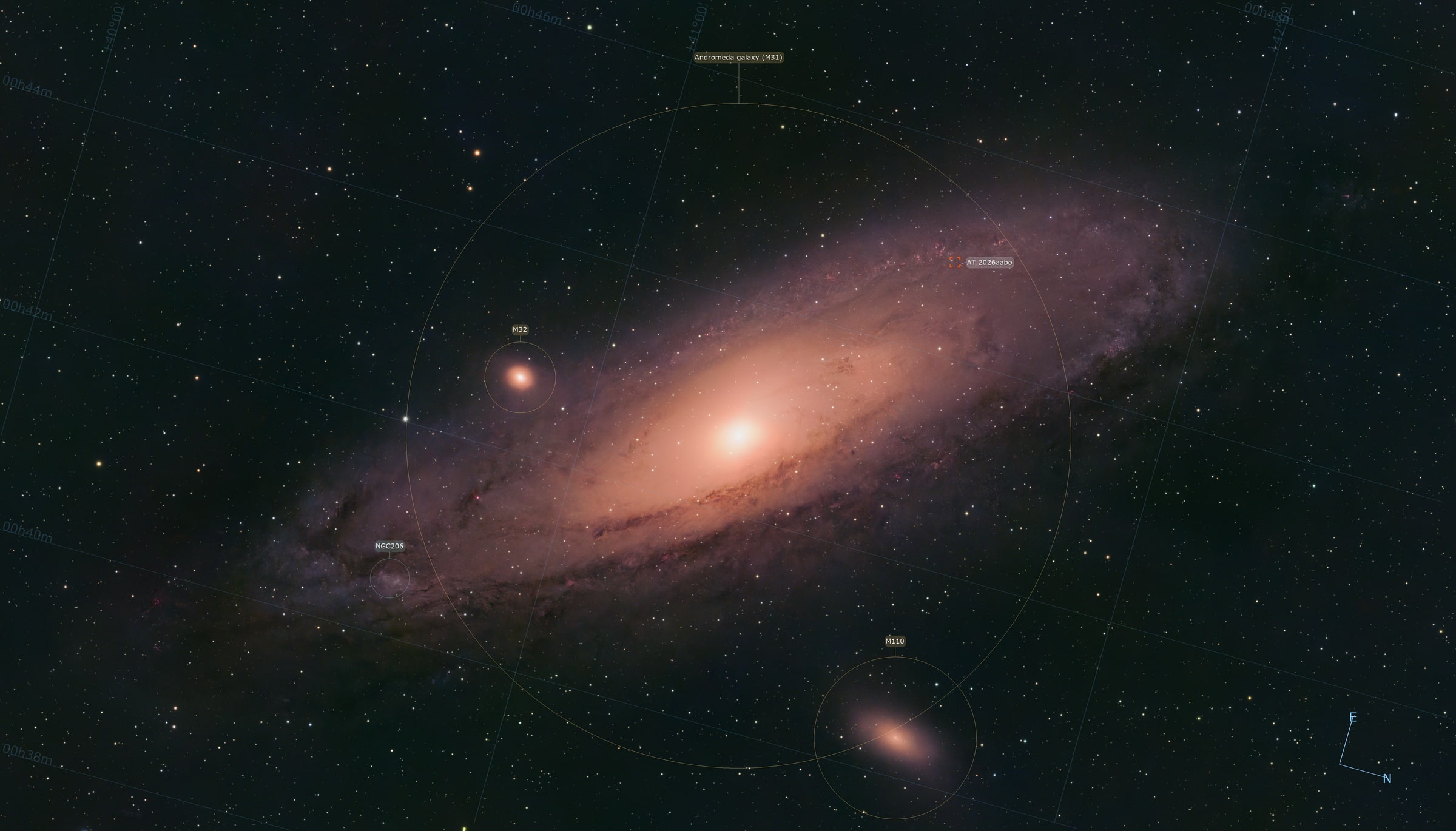
That visual ordinariness is part of what makes the comparison powerful. A nova does not arrive with a label. It becomes meaningful because its position is measured, its spectrum is observed, and earlier images establish that the source was not previously visible.
A nova, not a supernova
The words sound similar, but a nova and a supernova are very different events.
In a classical nova, a dense white dwarf orbits closely with another star. The white dwarf’s gravity draws hydrogen-rich material from its companion. That material accumulates on the white dwarf’s surface until rising temperature and pressure ignite runaway nuclear fusion. The resulting eruption can make the system brighten enormously, but it does not destroy the white dwarf. Given enough time to accumulate more material, the system may erupt again.
A supernova is vastly more energetic and can destroy or fundamentally transform the exploding star. That is what set SN 2026aaiv in NGC 7331 apart: a Type Ia supernova, recorded in a galaxy roughly 45 million light-years away. The similar names disguise profoundly different events. SN 2026aaiv marked the thermonuclear disruption of a white dwarf; AT 2026aabo is interpreted as an eruption on a white dwarf that survives.
This nova is much closer, inside the neighboring spiral that I had already been photographing for months. Its importance comes from watching a compact binary system flare dramatically in another galaxy—and from being able to compare that flare with observations made before it appeared.
The discovery record shows how quickly the nova changed. ZTF first detected it on August 29 at magnitude 18.578 in the g band. Follow-up with the GROWTH-India Telescope found it near magnitude 15.3 by August 31: more than 3.5 magnitudes brighter in less than three days. Spectra from the Himalayan Chandra Telescope showed Fe II and P-Cygni Balmer features associated with a nova near maximum light, as well as a velocity shift consistent with membership in M31.
Building a 25-hour Andromeda
The complete portrait combines data from nineteen sessions, beginning April 27 and ending September 9. The source material mixed 30-, 60-, 120-, and 180-second exposures. After quality filtering, 2,031 of 2,402 candidate frames remained, totaling 90,420 seconds—25 hours and 7 minutes.
| Dataset | Dates represented | Retained frames | Integrated exposure | Role |
|---|---|---|---|---|
| Full M31 master | Apr. 27–Sep. 9 | 2,031 | 25h 7m | Wide portrait and shared galaxy background |
| Pre-event comparison source | Before the late-August outburst | 1,372 | 16h 52m | Before stellar layer |
| Dedicated post-event stack | Sep. 8–9 | 572 | 7h 58m 30s | After stellar layer |
The full master was processed as a deep portrait in its own right. The nineteen stacks were registered with 1.5× drizzle, combined, rotated into the final orientation, plate-solved, cropped, and downsampled. Background extraction and spectrophotometric color calibration established the linear image; deconvolution, denoising, statistical stretching, curves, and star recomposition produced the final presentation.
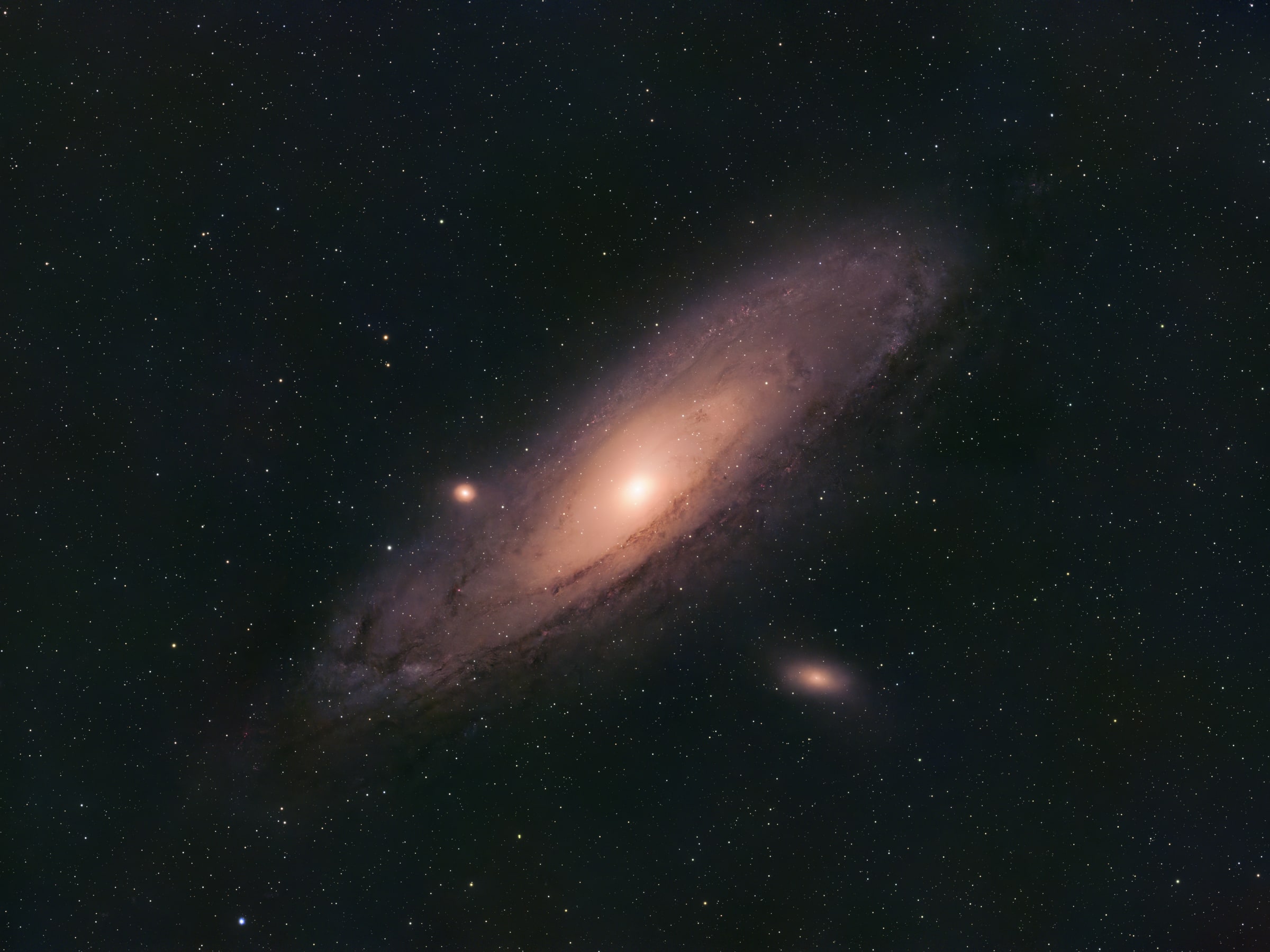
That finished portrait includes observations from both before and after the nova appeared, so it is not itself the evidence of change. Its role in the comparison is different: it provides a carefully developed galaxy background that can remain fixed while the time-sensitive stellar layer changes.
Holding the galaxy still
Making an honest-looking before-and-after image is harder than placing two photographs beside one another. The datasets differ in exposure time, noise, seeing, gradients, framing, and color response. If each image is developed independently, those processing differences can become more conspicuous than the transient itself.
I used a controlled composite instead.
First, the post-event stack, the pre-event source, and the full 25-hour master were plate-solved and registered into the same 1,812 × 1,359 detail frame. StarXTerminator then separated each registered image into a starless background and a stellar layer.
The final pair uses one shared starless crop from the full master. The Before frame places the cleaned pre-event stellar layer over that background. The After frame substitutes the stellar layer from the dedicated September 8–9 stack. This holds the galaxy’s treatment constant and concentrates the visible question in the point sources: what appeared?
Comparison
Andromeda Galaxy
Registered detail · 33.2 × 24.9 arcmin 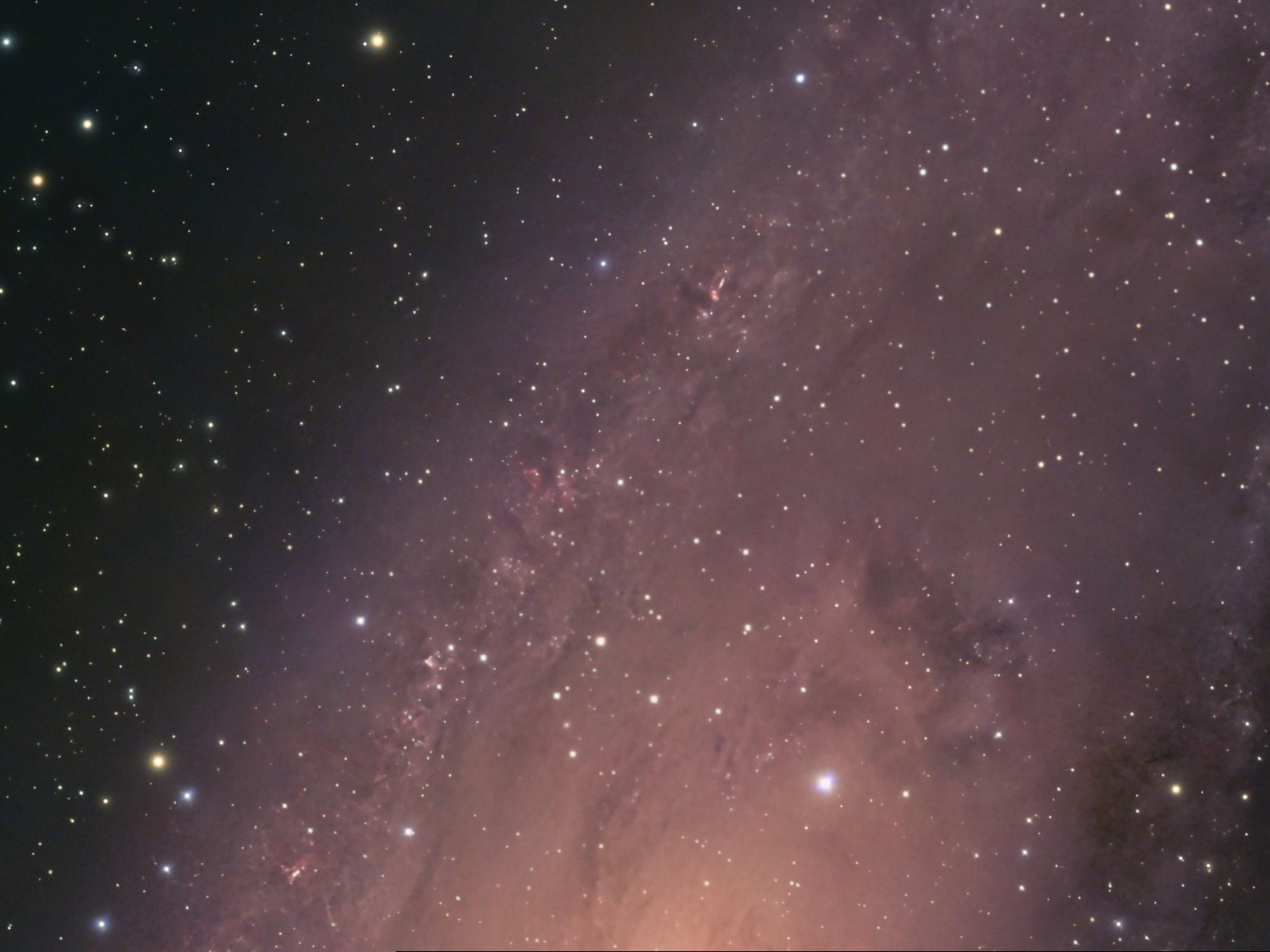 AT 2026aabo
  AT 2026aabo
 A matched view using a shared galaxy background and independently sourced pre- and post-event stellar layers.
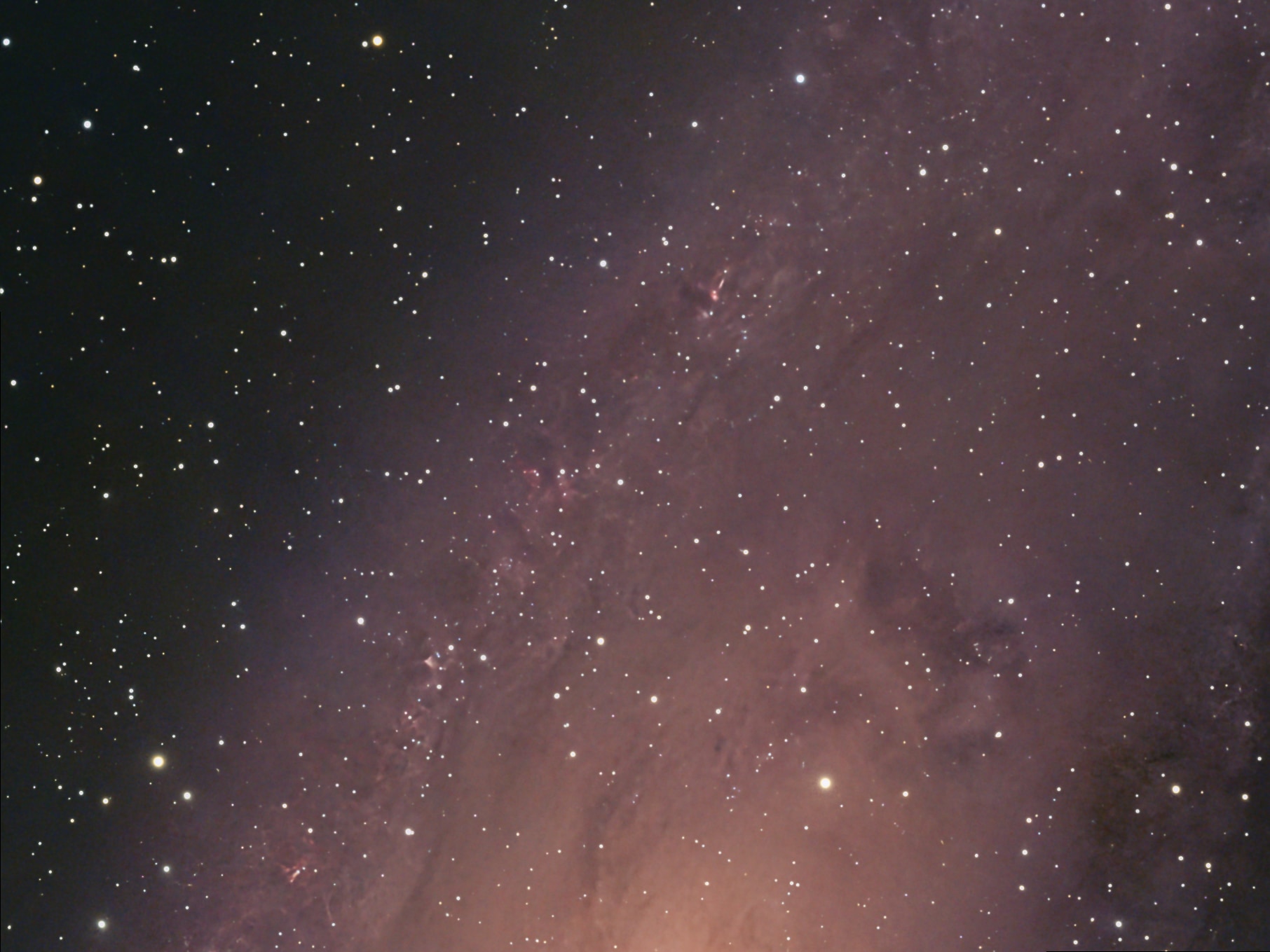
The nova is the bright blue-white point that appears near the lower-right portion of the detail field. Around it, many foreground stars remain nearly unchanged. Small color and shape differences are still visible elsewhere because the two stellar layers came from different nights and conditions, but the new source is unmistakable.
The useful failure in the middle
The processing session also produced a good example of why an editing history can matter.
After star recomposition, the detail crop repeatedly failed to plate-solve. The coordinates were correct and the stars were clearly visible, but the image carried scale metadata inherited from an earlier downsampled version: a 361.41 mm focal length paired with 2.57 µm pixels, implying 1.467 arcseconds per pixel. The registered comparison crop actually retained the earlier 1.100 arcsecond-per-pixel sampling.
Correcting the effective pixel size to 1.93 µm solved the crop in about one second. The solution placed the image center at 00h 44m 54.217s, +41° 33′ 17.792″, and the coordinate annotation landed exactly on the transient.
That detour is invisible in the final PNGs. It is obvious in the Siril log.
An archive becomes an observation
Astrophotography naturally encourages accumulation. More nights usually mean more signal, less noise, and a deeper final image. Old data becomes raw material for a better stack.
But every frame also records a moment.
The early M31 sessions were captured months before I knew AT 2026aabo would appear. They were not planned as transient monitoring, yet they became the control observation the moment a new point of light arrived in the same field. The September data then recorded the galaxy after that light reached Earth.
The full portrait contains twenty-five hours of accumulated detail. The scientific story comes down to something far smaller: one point that was absent, then present.
For roughly 2.5 million years, the light from that eruption crossed the space between Andromeda and the Milky Way. By chance, I had already been looking in the right direction before it arrived.
That is what made the archive a time machine.