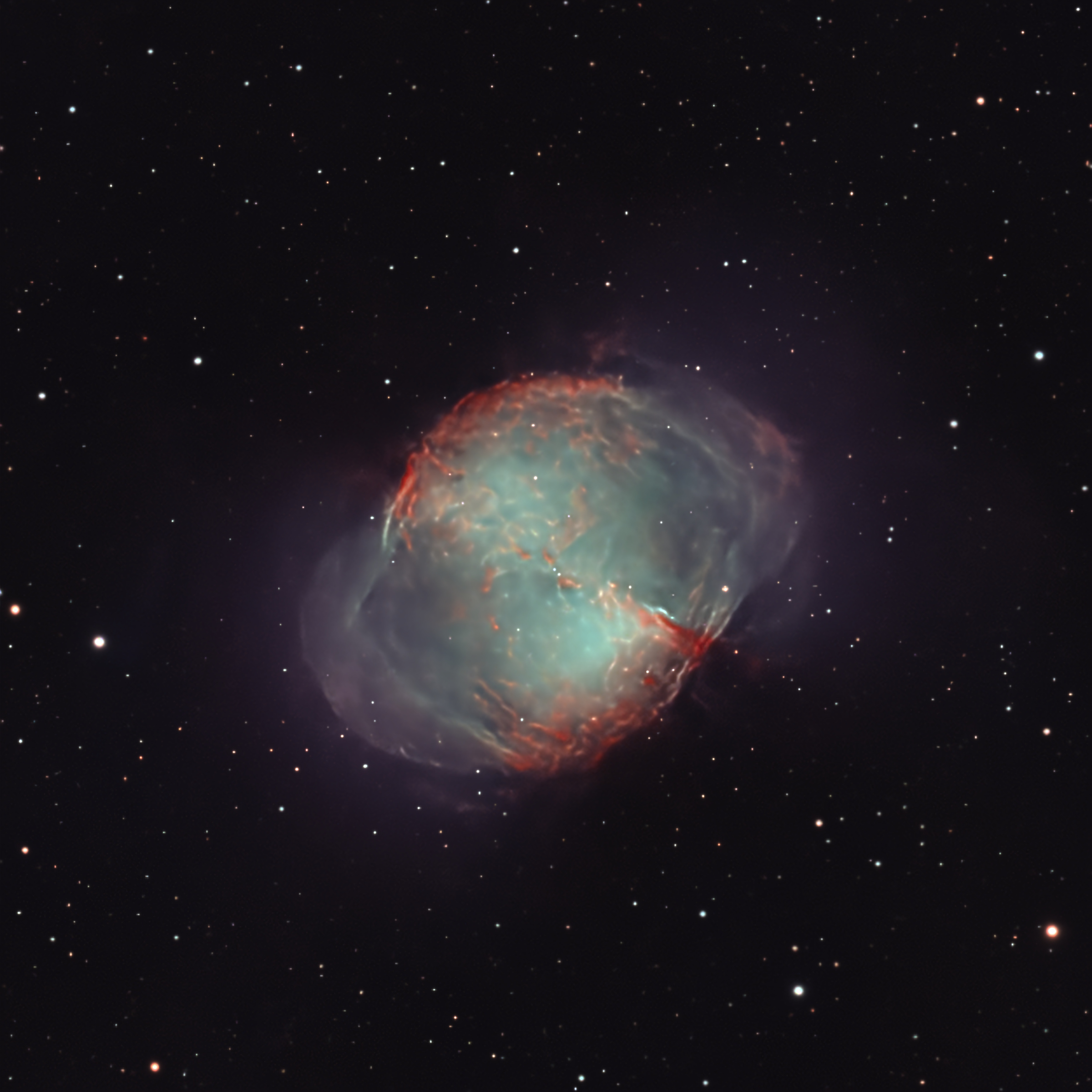
Processing experiment
A Step Too Far? AI Upscaling M27
A controlled processing comparison asks whether AI-assisted super-resolution reveals spatial detail encoded in M27 data—or introduces structure that is not there.
Research question
Can AI-assisted super-resolution reveal spatial detail already encoded in astrophotography data, or does it introduce plausible-looking structure unsupported by the observation?
This experiment compares three treatments of the same M27 crop: the image at its native scale, a 4× enlargement produced with Cosmic Clarity Super-Res, and a 4× conventional enlargement produced with Lanczos-4 interpolation in Siril. The enlarged versions received the same final sharpening treatment so that the comparison would focus as closely as possible on the enlargement method itself.
Subject and objective
M27, the Dumbbell Nebula, is a planetary nebula about 1,250 light-years away in Vulpecula. It formed when a Sun-like star expelled its outer layers near the end of its life, leaving a hot white dwarf whose ultraviolet radiation now ionizes the expanding gas.
The blue-green regions are dominated by emission from ionized oxygen (OIII), while the red structures primarily trace hydrogen (Hα) and nitrogen (NII). A much fainter outer shell records earlier episodes of mass loss and shows that M27 extends considerably beyond its familiar bright central dumbbell.
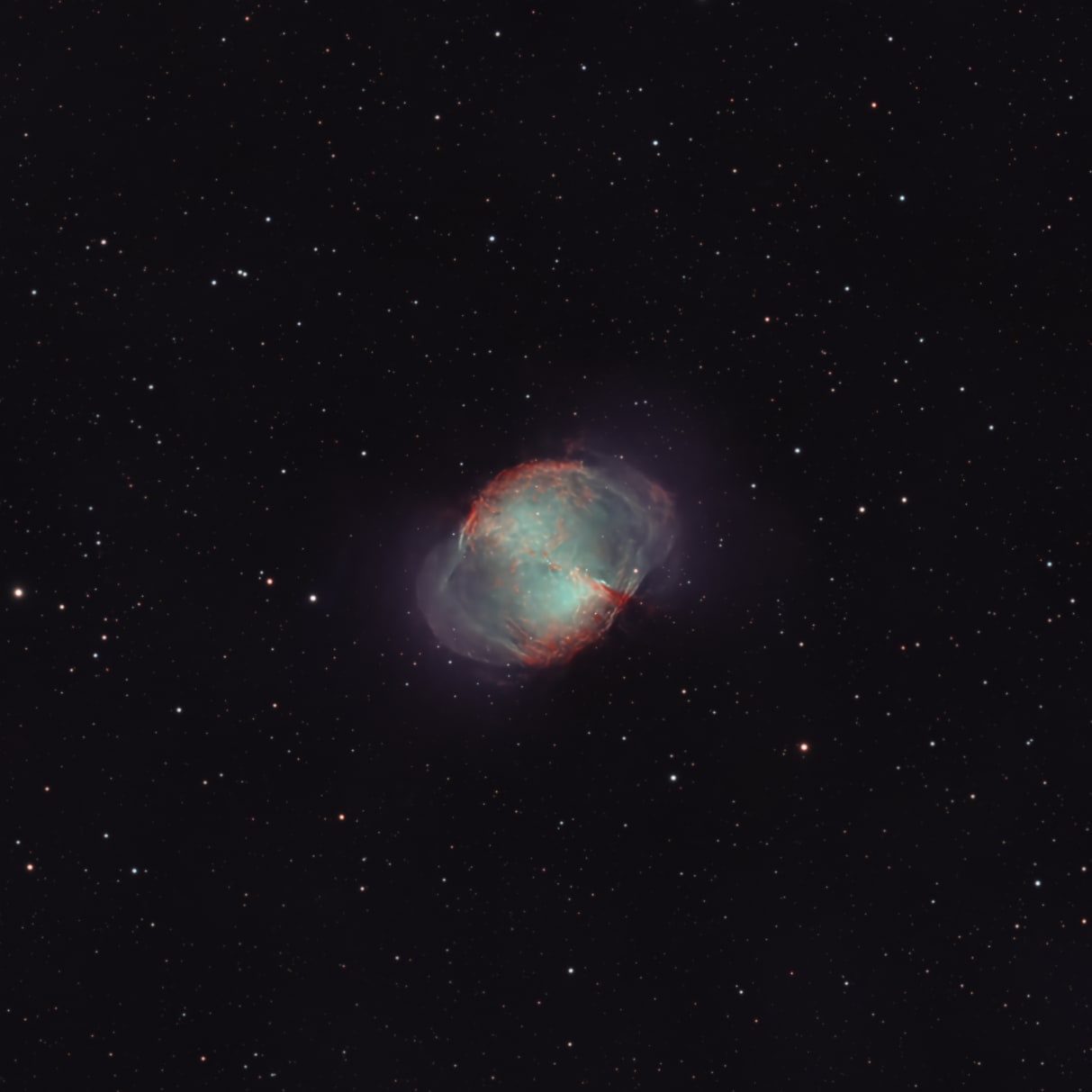
My original objective was to uncover and highlight that faint outer shell. With approximately five hours of Seestar S50 data, I was not sure there would be enough signal to reveal it. Careful stacking and restrained post-processing brought at least part of the shell into view. The super-resolution question emerged later, when a square presentation crop looked stronger compositionally but felt too small to publish at its native dimensions.
Methodology
Source data and stacking
The source data came from eight sessions captured between February and July, ranging from 30 minutes to two hours. Most sessions used 30-second sub-exposures; one used 10-second subs and another used 60-second subs.
Those sessions varied in target altitude, seeing, gradients, lunar influence, and noise. I therefore stacked and performed basic cleanup on each session independently before combining the cleaned session stacks into a final master.
Each session was stacked in Siril with the Naztronomy script using 1.5× drizzle and a 0.6 pixel fraction. Rejection stacking removed outliers above 3.0 sigma, and noise weighting reduced the influence of lower-quality data. Cleanup included cropping, plate solving, GraXpert background removal, and spectrophotometric color calibration using the Seestar S50 profile with its internal light-pollution filter.
Baseline processing
I performed initial cleanup of the master with BlurXTerminator, NoiseXTerminator, and StarXTerminator. A simple Statistical Stretch diminished the shell and overexposed the core, so I switched to Generalized Hyperbolic Stretch and alternated hyperbolic and linear stretches to reveal the shell gradually while preserving the bright central structure.
VeraLux Curves helped isolate the nebula and attenuate the blue, green, and luminosity channels. AstroColorMixer provided an additional mask for the outer shell so I could increase its luminance without substantially changing the bright nebula or background. I finished the starless image with SCUNet DSO Ubersmooth denoising and non-stellar sharpening in BlurXTerminator.
The star field was stretched independently and recomposed with the nebula using Siril’s Star Recomposition tool. Final contrast adjustments used VeraLux Curves and GHS.
Controlled comparison
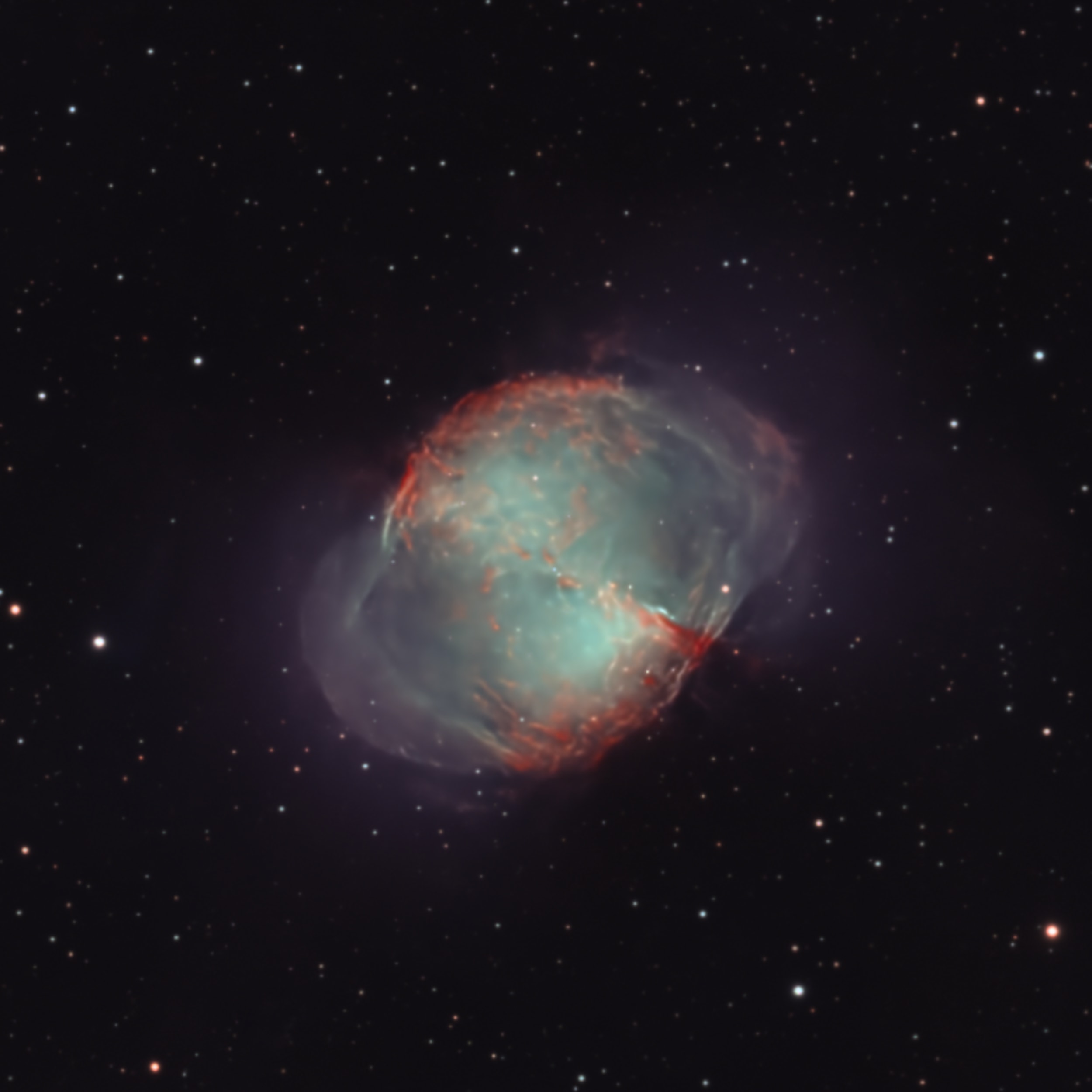
I made the square crop only after completing the baseline image. From that same pre-enlargement crop, I created three comparison views:
- Native: no enlargement; this is the reference image.
- Superres: 4× Cosmic Clarity Super-Res, followed by BlurXTerminator sharpening of the stellar and non-stellar components.
- Lanczos-4: 4× Siril Geometry/Resample using Lanczos-4, followed by the same BlurXTerminator treatment.
Cosmic Clarity describes its method as applying bicubic upscaling first and then using AI to enhance the final detail. That makes the Super-Res result neither a simple interpolation nor an unconstrained text-to-image generation. The experimental question is whether its learned enhancement remains grounded in the structures present in this particular observation.
Results
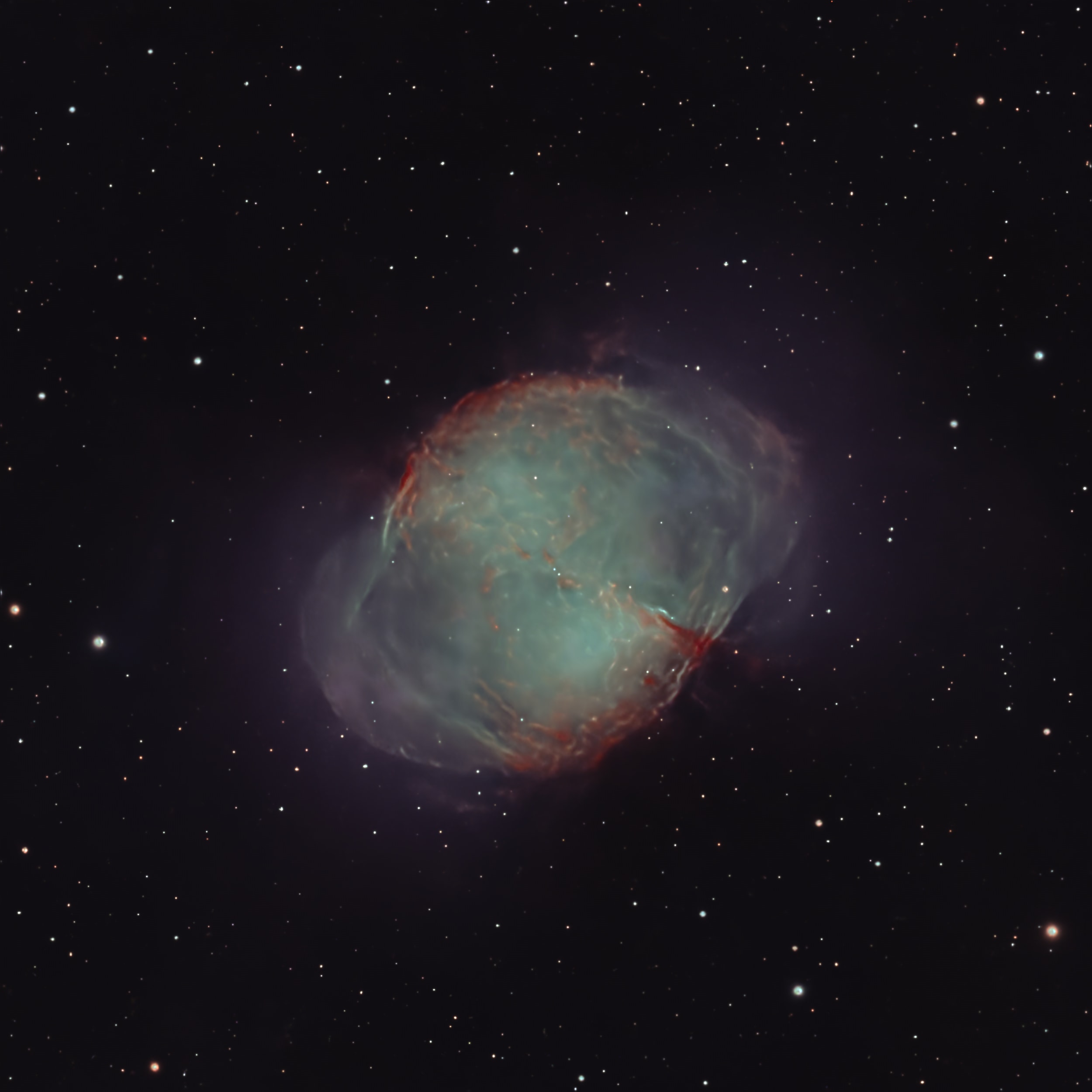
The Superres result looked excellent—and made me uncomfortable. It showed substantially more apparent detail in the bright nebula and in the faint shell. The central question was whether that structure had been hidden in the original data and recovered by the model, or whether some of it had been manufactured from patterns learned during training.
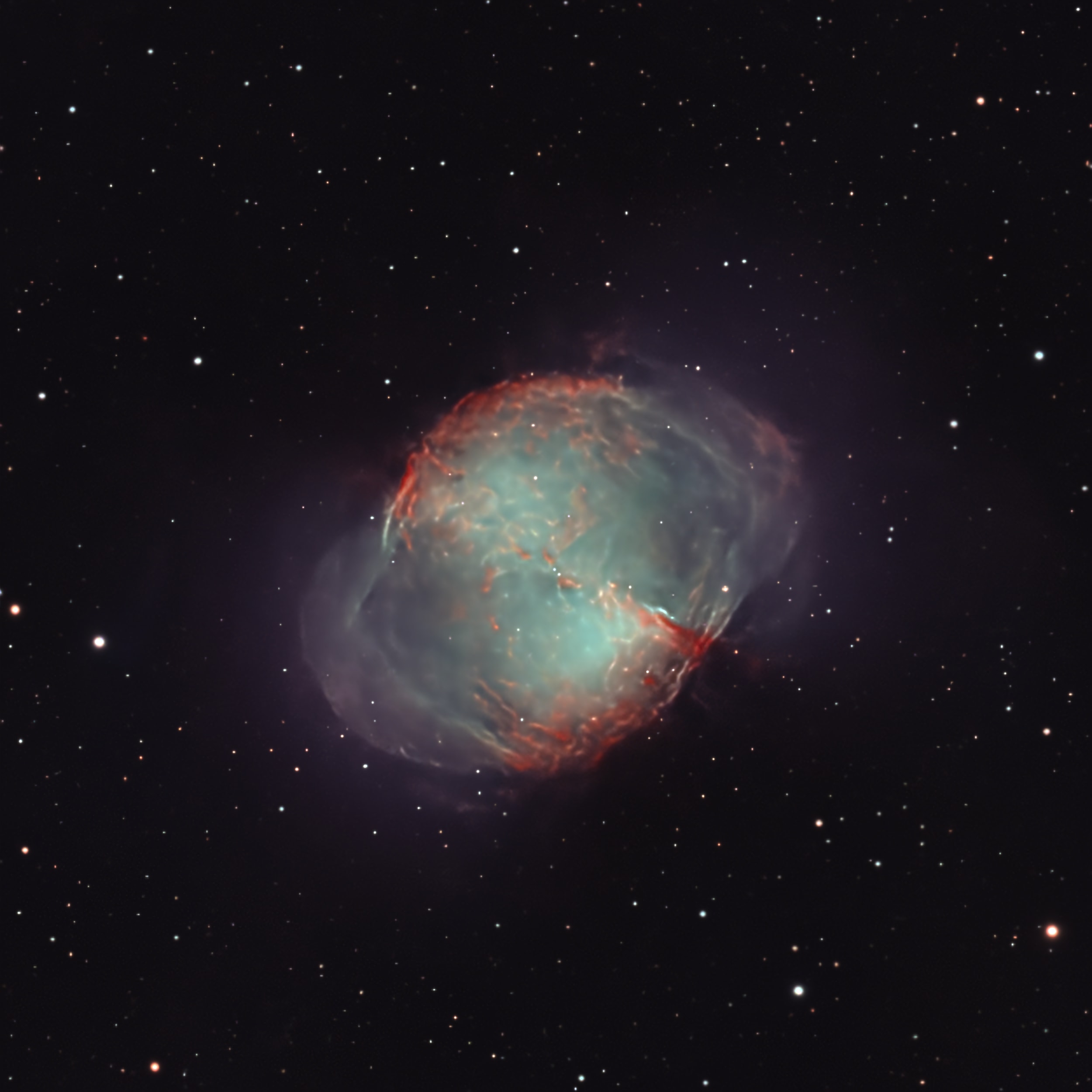
The conventionally enlarged result was remarkably similar. Many of the same filaments, edges, knots, and shell structures appeared in both enlarged versions. The two outputs are not identical, and similarity alone cannot validate every reconstructed feature, but the agreement was stronger than I expected.
The interactive comparison below opens with Native versus Superres. The selectors also allow a direct Superres/Lanczos-4 or Native/Lanczos-4 comparison.
Interpretation
Simply making an image larger does not create additional observational information. This experiment instead suggests that the native image contained spatial information that was difficult to perceive at its original pixel scale. Two different computational paths made many of the same structures easier to see.
That agreement increases my confidence that a substantial portion of the apparent detail in the Superres version is grounded in the captured signal. It does not prove that Cosmic Clarity’s model is non-generative, nor that every tiny feature in the enhanced image maps perfectly to physical structure in M27.
The Lanczos-4 result is therefore a useful control, not a proof. It asks a narrower question: if a conventional enlargement and the AI-assisted treatment both expose the same larger-scale structures, is the AI result plausibly emphasizing information already present rather than inventing the overall morphology? In this case, the answer appears to be yes.
Limitations
- The comparison begins with one processed master, so any artifacts introduced during stacking, stretching, masking, or deconvolution are shared by all three variants.
- BlurXTerminator was applied after both enlargements. Although the settings were held constant, it is itself a learned reconstruction tool and may interact differently with the two enlarged inputs.
- Visual agreement is qualitative. This is not a pixel-level residual analysis, a blinded evaluation, or a comparison against independently captured higher-resolution data.
- Agreement at the scale of major filaments and edges does not validate every small reconstructed texture.
- The result applies to this image and workflow; it should not be generalized automatically to every target, model, or super-resolution setting.
Conclusion
This experiment moved Super-Res from a tool I had avoided to one I am willing to use cautiously and disclose clearly. For this M27 image, the strong structural agreement between the AI-assisted and conventional enlargements gives me reasonable confidence that the Superres treatment is primarily revealing information encoded in the source data rather than replacing the observation with an imagined nebula.
I am still deciding where to draw the line with AI-assisted astrophotography. For now, the most useful distinction is this:
The photons captured by the camera sensor are the raw observation. Everything that happens afterward—debayering, registration, stacking, deconvolution, denoising, stretching, color calibration, and enlargement—is a computational transformation intended to turn those measurements into an interpretable representation of the light that reached the sensor.
My goal is to make sure those transformations preserve and reveal the astronomical information in the data as faithfully as possible. When independent processing approaches recover similar structures from the same observation, that agreement provides useful evidence that the computation is revealing information encoded in the data rather than diverging from reality.
Comparison
Dumbbell Nebula
Compare the Native, Superres, and Lanczos-4 treatments of the same crop.
Technical addendum: display size and source resolution
All three comparison panels are presented at the same 2500 × 2500 pixel dimensions and the same on-screen size so that the split viewer can align them directly. The file labeled Native is therefore up-resed for the comparison display: “Native” describes its information content and processing path, not the dimensions of the displayed file.
The Superres and Lanczos-4 versions are both 4× enlargement treatments of the original crop and carry the corresponding higher sampling density. The Native panel was scaled only to match their comparison canvas. Its additional display pixels do not contain additional observational information.