Story
North America on Fire‐ Capturing the NGC7000 region
A planned competition entry found new relevance in response to real world events
In July 2026, I began planning, capturing, and processing data for a monthly competition announced by an Astronomy community. The competition was delayed, but I continued working on the image, and found new meaning in my data in light of real world events.
I am a member of an Astronomy and Astrophotography group on facebook, which periodically holds imaging contests with really generous prizes. In early July, 2026, the group announced a competition with a prize that I was really excited for the opportunity to win; an SVBONY MK127 telescope. I had been following these competitions for the previous months, and paying close attention to how they often progressed. These competitions are often decided by polls, are are often driven by popularity- there are often dozens of participants, and though the winning images are often very nice, image quality is rarely the only, or even main, factor in choosing the winner.
If I chose to participate in this competition, I would have to do so strategically; There are certainly going to be competitors with much more expensive gear, and much larger social media footprints. My best chance at winning was by choosing a subject that was well suited to my equipment and skill, and presenting it in a unique way, to stand out from the crowd of other submissions.
Finding the right subject for the right nights
The first question was straightforward: What was available now?
More specifically, what was going to be high in the sky and in an optimum position for imaging during the nights I had available?
I used the planning features in AstroGuide to look ahead. SkySphere and Search Explorer helped me see what the sky would look like over the next several nights and identify the subjects that would be well positioned during the best imaging hours.
The weather and lunar conditions also happened to line up unusually well. The competition was announced just as we were approaching the new moon, and AstroGuide’s 10-night forecast showed a promising run of cloudless nights during the darkest part of the lunar cycle.
I had something close to the ideal scenario: four potentially clear, moon-free nights.
That gave me a defined capture window. Instead of asking, “What would I like to photograph someday?” I could ask a much more useful question:
What is going to be in the prime part of the sky during these four specific nights?
That distinction shaped the entire project.
In looking at previous winners, a few trends emerged. winners were often:
- Large subjects, often wide fields with multiple separate nebula
- Narrowband processing, often combining data from multiple filters to create SHO or Hubble Palette images
- Long integration- winning images often combined data from multiple sessions, spanning dozens of hours.
With these factors, the search was on to find a subject that checked these checkboxes.
The most popular subject: Eagle Nebula
The Eagle Nebula was a strong candidate. With its iconic Pillars of Creation, along with its dramatic surrounding areas (from Nest Nebula down all the way through Soul Nebula, M24, and the Triffid and Lagoon Nebulas), this rich region is filled with amazing options, all tailor made for SHO/Hubble palette treatments.
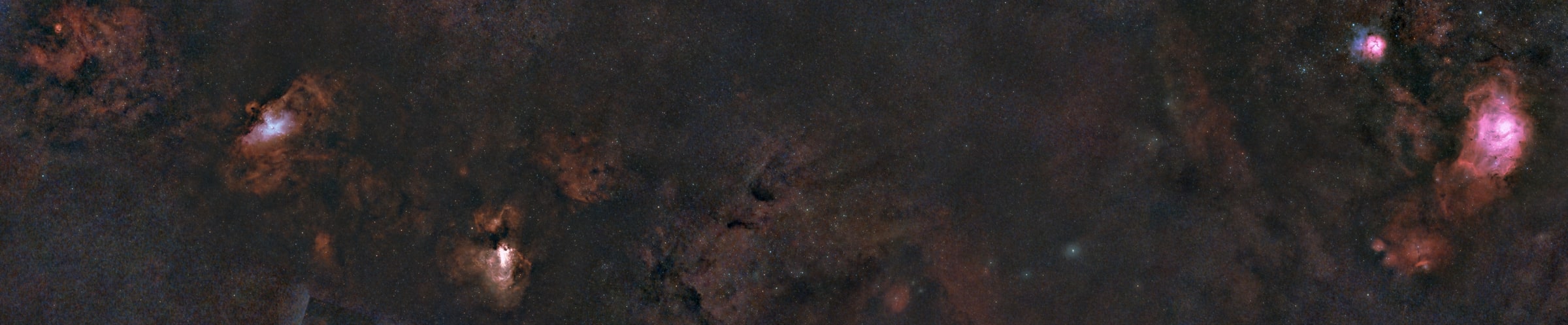
The challenge, though, is that it was already incredibly popular. There were dozens of posts, every day, presenting these subjects in a variety of palettes, framings, and interpretations. Though I have been creating images of this region that I was personally proud of, I didn’t think my Seestar-centric results would hold up to competitors with rigs with significantly higher budgets. I was not going to win a hardware arms race.
My advantage, if I had one, needed to come from planning, integration time, composition, and doing something a little different with the equipment I already had.
Working with what I have: North America Nebula
There was another practical consideration: existing data.
Long integration is incredibly valuable, especially when working with modest equipment. I had four new nights available, but I did not necessarily need to start from zero. I began looking at what I had already captured and asking:
What can I add four nights of data to, rather than beginning an entirely new project?
AstroGuide helped me see that I already had useful data for the North America Nebula.
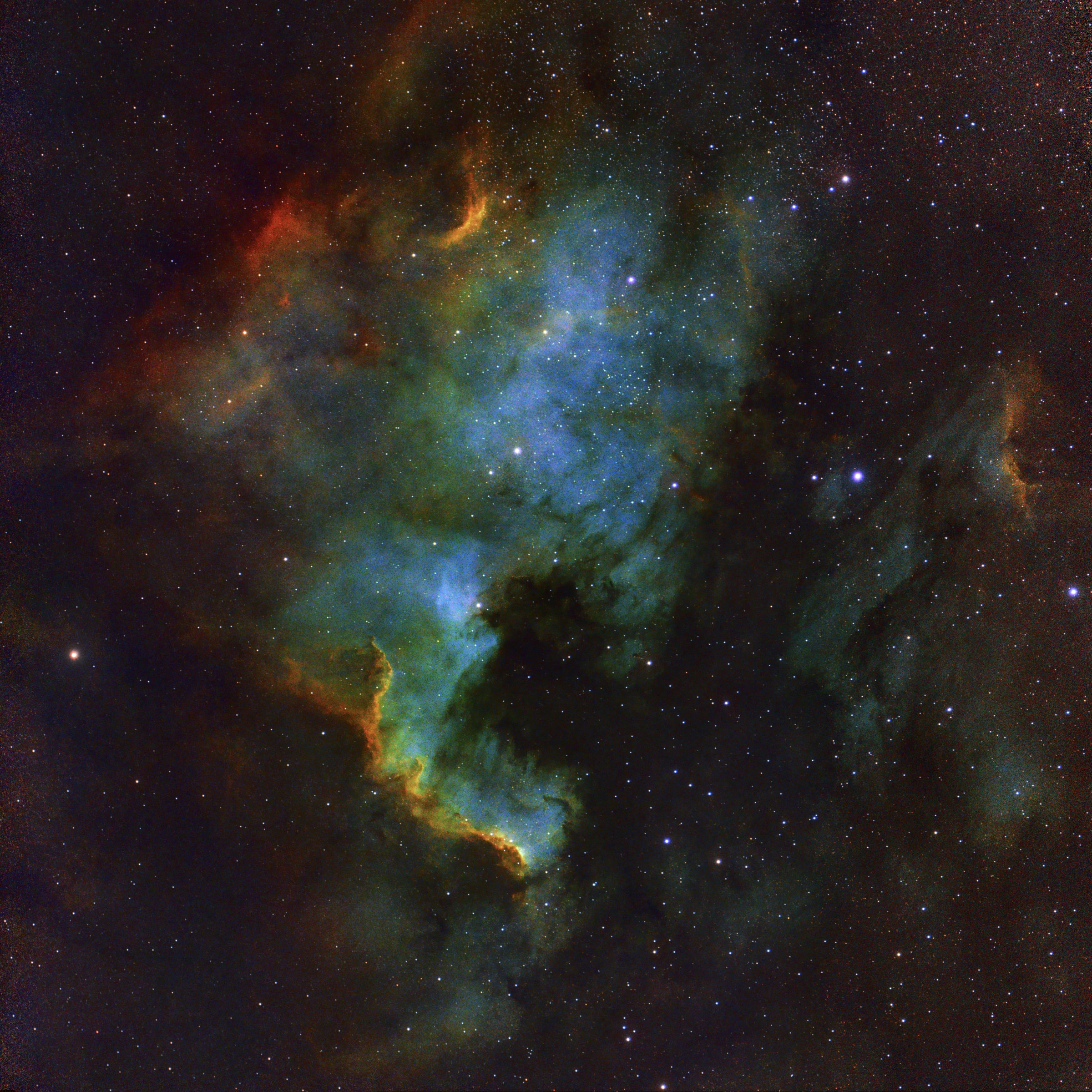
That made NGC 7000 an increasingly strong choice. It was well placed during my capture window, it was appropriate for an SHO image, and I already had a foundation I could build on.
Finding the composition in AstroGuide
Once I had settled on the North America Nebula, the next question was framing.
My main wide-field system was an FMA135 paired with a Nikon D5300, mounted on an experimental wide-field rig that I had been building. Because I was still relatively new to that particular telescope-and-camera combination, I wanted to know exactly what field of view it would produce before I committed a clear night to it.
I built the combination in AstroGuide’s telescope configuration tool and brought it into Capture Studio. That gave me the actual field of view of the FMA135 and D5300 over the target.
That was where the project became more interesting.
When I looked at the wider region around the North America and Pelican nebulae, I noticed the Clamshell Nebula sitting nearby. It is rarely included in the standard North America composition, especially in images framed primarily around NGC 7000 and the Pelican.
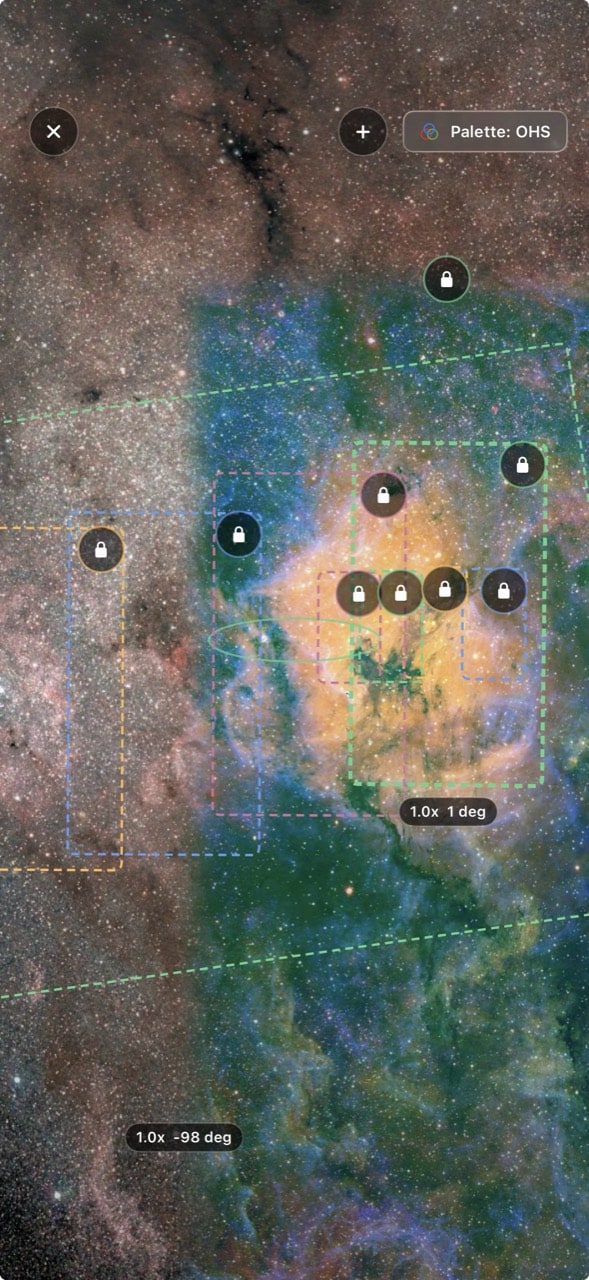
That immediately became the frame I wanted.
Instead of producing another close view of the North America Nebula, I could create a wide composition containing:
- the North America Nebula,
- the Pelican Nebula,
- and the Clamshell Nebula.
The Clamshell gave the image a wider sense of place. It made the composition feel less like an isolated portrait of one famous object and more like a view into a larger region of Cygnus.
AstroGuide did not merely confirm that the target would fit. It helped me discover the composition.
NGC 7000 set the stage for a solid choice:
- North America, when combined with Pelican, Clamshell, and Foresaken Nebulae, composed the expansive canvas I was hoping to find.
- This region has an interesting mix of Hydrogen-Alpha and Oxygen rich subjects, with broad Sulfur emissions as well- this makes it great for SHO or other palettes.
- By combining my existing data and the four nights available, I could capture enough data to create the long integration required.
One target, three telescopes
I also wanted the project to highlight my multi-telescope strategy.
Instead of having one expensive, highly optimized imaging rig, I have two Seestar smart telescopes and an experimental traditional astrophotography rig, based on the Askar FMA135 and a stock Nikon D5300 DSLR. I liked the idea of taking data from all three and combining their different strengths into a single project.
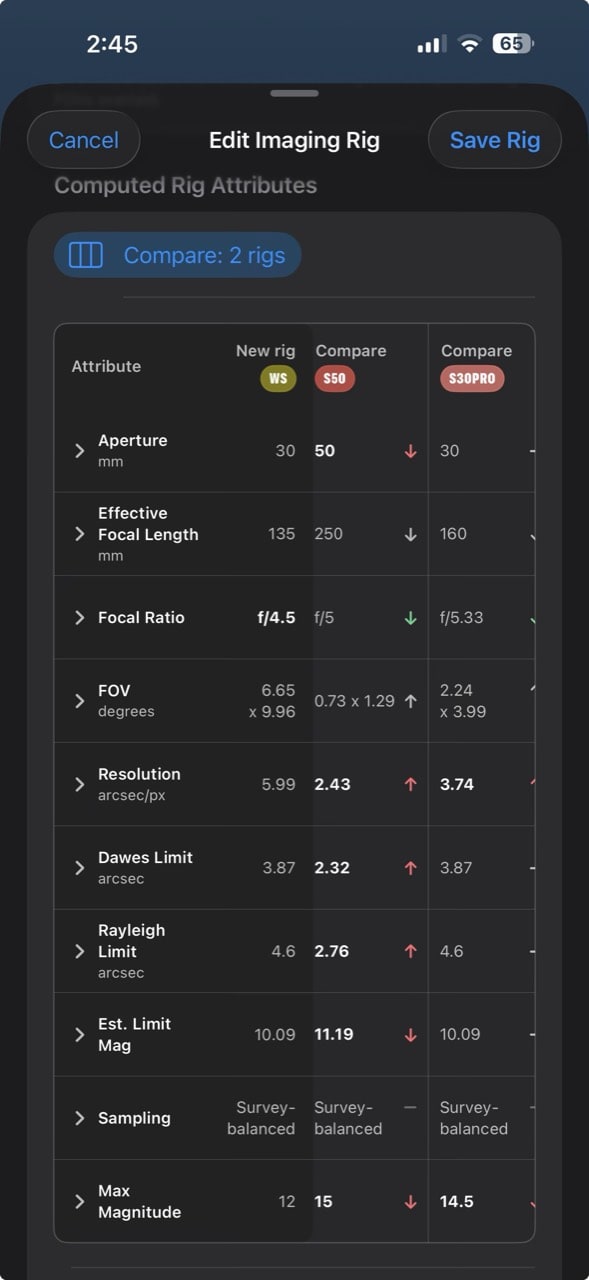
It felt like an opportunity to do something genuinely different.
The plan was to give each telescope a specific scale and role.
The FMA135: the establishing frame
The FMA135 and Nikon D5300 would capture the main wide field. This was the image that would establish the full composition: Clamshell, North America, Pelican, and the larger emission complex around them.
My original intention was to devote one night to the L-eXtreme filter for H-alpha and OIII, then another night to the SV220 for the sulfur side of the SHO data.
The S30 Pro: the medium-scale panels
The S30 Pro would capture a series of medium-field panels centered on the main structures:
- the Clamshell Nebula,
- the North America Nebula,
- and the Pelican Nebula.
These panels would provide additional signal and structure at a different image scale. The goal was not simply to paste sharper sections into the wide field. I wanted the S30 Pro data to reinforce the major regions and give me more depth when I eventually constructed the SHO channels.
The S50: the tight details
The S50 had the narrowest role.
I wanted it to capture tight “hero” views of the dust structures, particularly:
- the Cygnus Wall,
- and the dark lane between the North America and Pelican nebulae.
The idea was to use those close views as selective detail data during processing. The FMA135 would set the scene, the S30 Pro would reinforce the main nebulae, and the S50 would get intimate with the dust.
At least, that was the plan.
The data-volume problem
Running three telescopes at the same time changes the meaning of a single night.
Each telescope could collect roughly five to six hours of prime data. Across three systems, that meant I was potentially capturing 15 hours or more of data per night.
That was far more than I could fully process before the next clear night began.
This became an important part of the experience. I was not able to finish stacking and evaluating one night before I had to decide what all three telescopes would do on the following night. Some of those decisions had to be made based on live views, quick inspections, and incomplete information.
The clear-weather window was too valuable to pause.
Night one: three experiments at once
For the first night, I tried to make full use of all three systems.
The FMA135 captured through the L-eXtreme filter, beginning the wide-field H-alpha and OIII foundation.
The S30 Pro used only its built-in light-pollution filter because I wanted to experiment with Milky Way mode. I liked the idea of having an even wider establishing view of the entire region. I did not know whether it would ultimately become part of the competition image, but I wanted the option.
The S50 went after early sulfur data using the SV220 in mosaic mode.
That last part did not work well.
Mosaic mode was simply too slow for the job. Because the S50 had to move among multiple panels, the already-limited integration was divided across a larger area. For a relatively faint signal like SII, the process was not efficient enough.
The first night of S50 sulfur data was not especially useful.
The S30 Pro experiment also had problems. I did capture Milky Way-mode data, but it was not crisp. Between some cloudiness and what appeared to be a focus problem, the result did not have the quality I expected.
I eventually revisited the idea, but the first attempt was rough.
That made night one an immediate lesson in the difference between an experiment that sounds efficient and one that is actually efficient. On paper, all three telescopes were collecting useful data. In practice, two of the three systems were also testing capture methods that had not yet been proven for this project.
Night two: the plan gets more serious
I had not fully processed all of night one before night two arrived, so I moved ahead with the original filter rotation.
Because the FMA135 had captured L-eXtreme data on the first night, I switched it to the SV220 on night two. The goal was to capture the sulfur data that I would pair with the L-eXtreme data for the final SHO image.
The S30 Pro received the L-eXtreme filter and began capturing the medium-scale H-alpha/OIII panels for Clamshell, North America, and Pelican.
I had already learned that the S50 mosaic was too inefficient, so I abandoned that approach. Instead, I installed the L-Pro and used the S50 for the tight dust-lane details I had originally envisioned.
That part of the plan was now much more focused: no mosaic, no attempt to cover the whole region—just targeted views of the structures where the S50’s narrower field could contribute something distinctive.
But while the FMA135 was collecting its SV220 data, I began to notice that something seemed off.
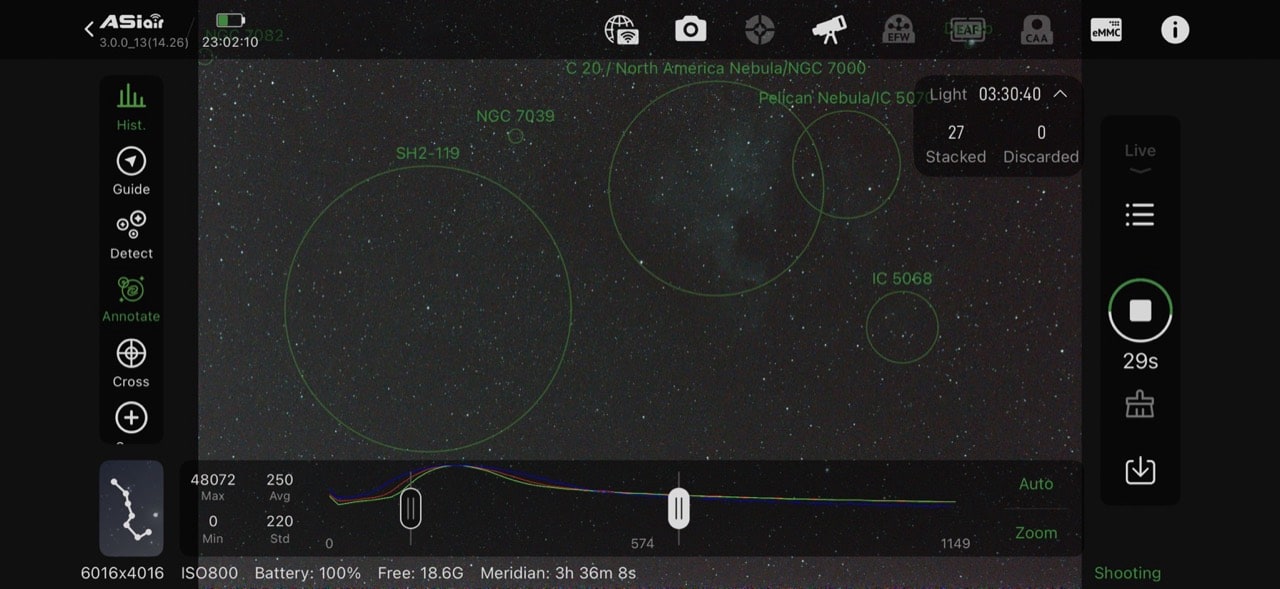
The live view did not look like the sulfur data I was accustomed to seeing. It was very blue-green, and I was not seeing much red at all.
I was not immediately sure whether that meant the capture had failed. SII is normally the faintest of the SHO channels, so perhaps the signal was simply weak. Calibration with lights, darks, and bias frames was also still relatively new to me after coming from the Seestar workflow. I could not rule out a calibration or preview issue.
Still, the absence of red was concerning.
The next morning, I brought the camera data into processing and checked it as quickly as I could.
There was essentially no useful SII signal in the red channel.
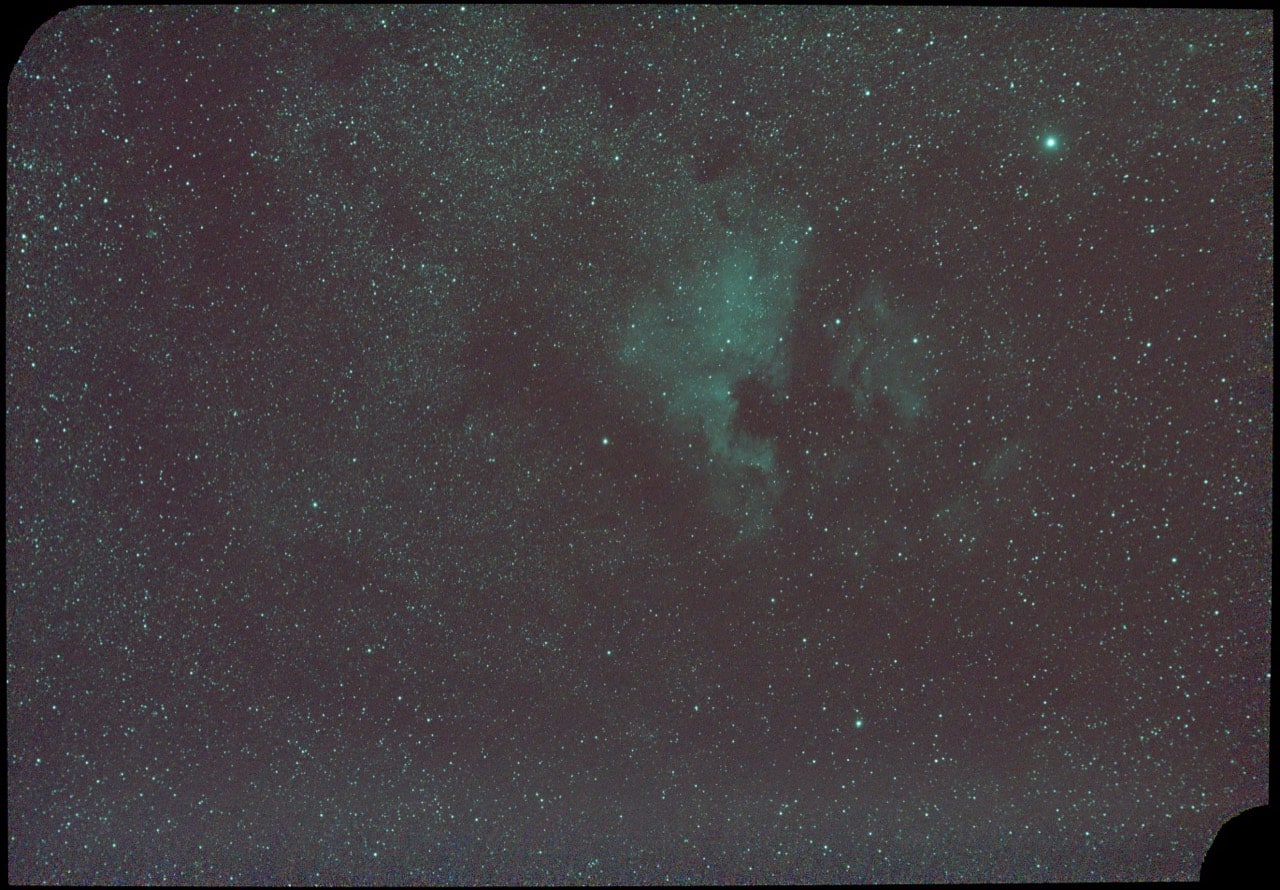 Autostretched color viewThe autostretched color view revealed usable nebular structure, but not the sulfur balance needed for the intended palette.
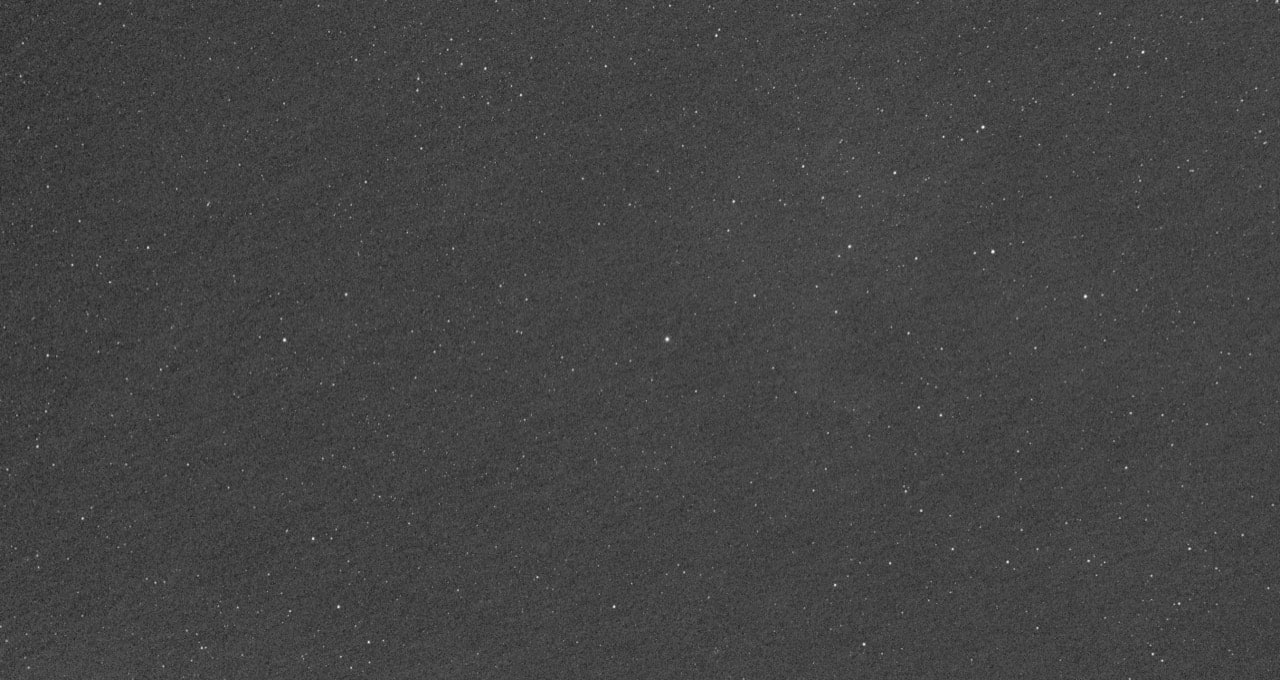 Red channelThe red-channel inspection showed essentially no useful SII signal.
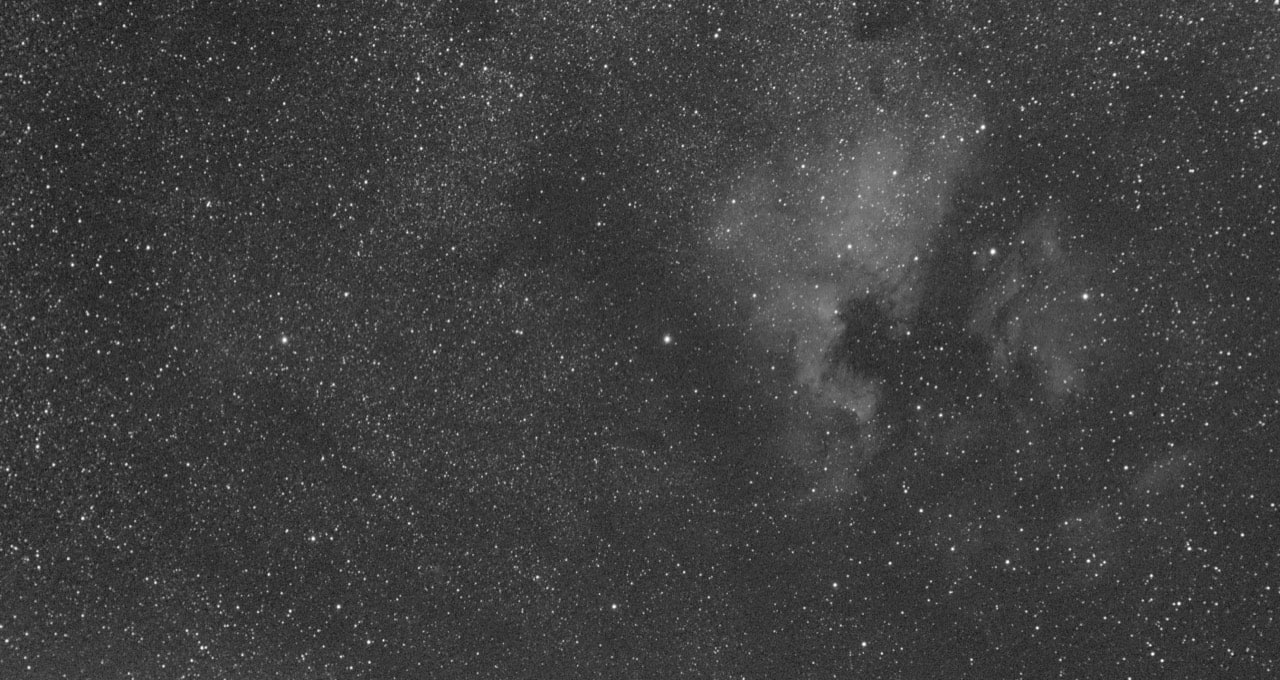 Blue channelThe blue channel retained clear nebular structure, confirming that useful OIII data had been captured.
After researching the issue, I concluded that the Nikon D5300’s internal filtering was suppressing the deep-red response far more aggressively than I had expected for this filter combination. Whatever the exact balance of camera response and filter transmission, the practical result was clear: the FMA135/D5300 system had captured good oxygen data, but it had not captured the sulfur data I needed.
A night that was supposed to complete the wide-field SHO set had effectively become another OIII night.
The data was not worthless. The oxygen signal was useful. But in terms of the mission I had assigned that telescope, the night was a failure.
Night three: rerouting the entire sulfur plan
By the third night, I knew the FMA135 and D5300 were not going to give me the wide-field SII data I had expected.
I needed to reassign the work.
The FMA135 went back to L-eXtreme duty and captured another night of H-alpha/OIII data. It could still make the wide-field foundation deeper and cleaner, even if its role in the sulfur channel had failed.
The SV220 moved to the S30 Pro.
I then captured a series of SII-oriented panels with the S30 Pro over Clamshell, North America, and Pelican. This was now my best chance of collecting the sulfur signal required to construct the SHO image.
This pivot was where the multi-telescope strategy proved its value.
The original plan had failed, but the overall project had not. Because the S30 Pro could take over the sulfur role, I still had a path forward. The final distribution of work no longer matched the diagram I had imagined before night one, but the necessary signals could still be captured.
The S50, meanwhile, had already completed the targeted L-Pro dust-lane work I wanted from it. Its field of view was too small to make it an efficient substitute for the missing wide sulfur data, and I did not want to spend another entire night duplicating the same dust panels.
So, on night three, the S50 was free to explore some unrelated targets.
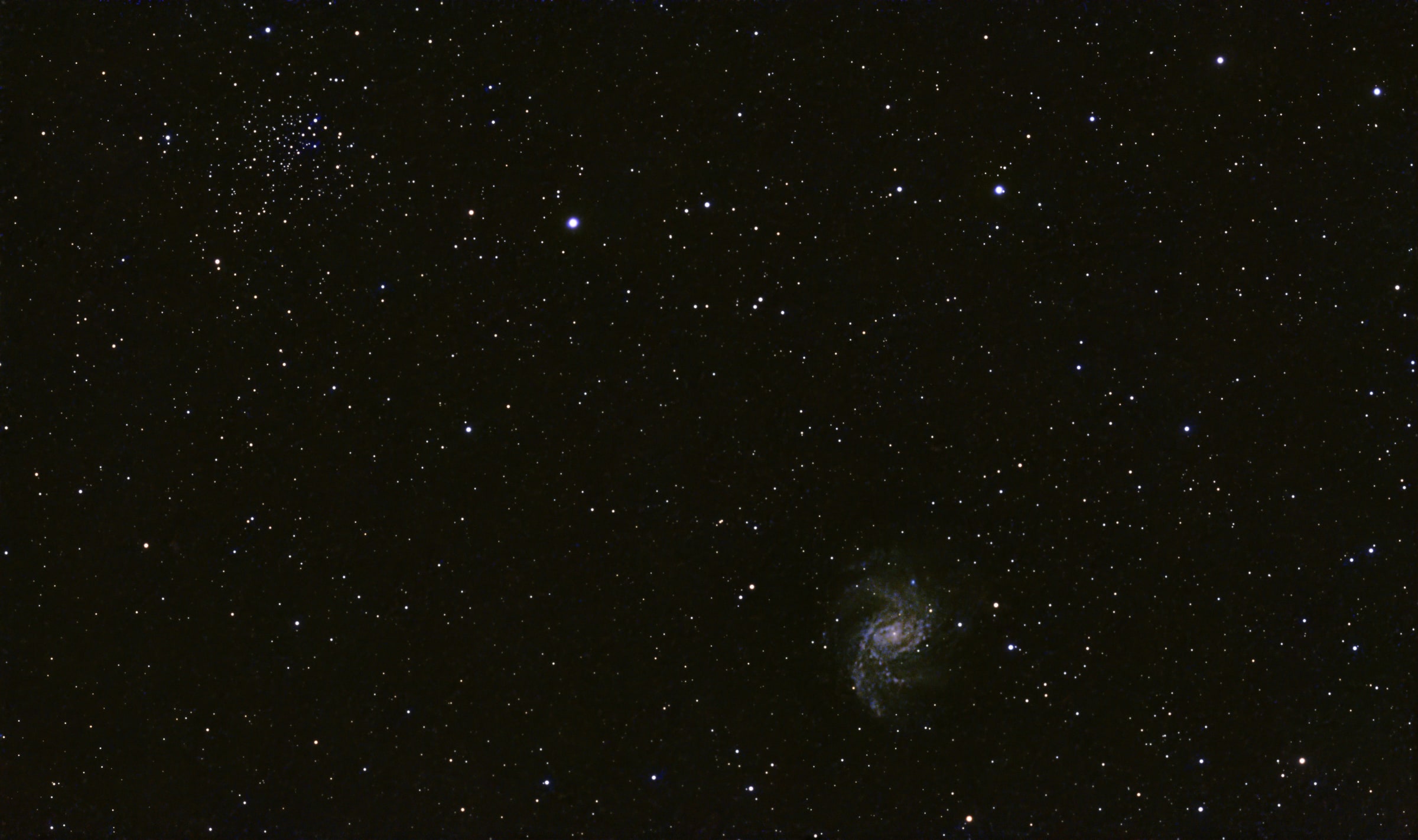
The capture plan I ended with was not the plan I started with
By the end of the capture run, the project had evolved significantly.
The FMA135 still provided the wide-field foundation, but it contributed mostly H-alpha and OIII rather than the balanced H-alpha/SII pair I had intended.
The S30 Pro became more important than originally planned. Instead of simply reinforcing the main nebulae at a medium scale, it also became my best source of sulfur data.
The S50’s most useful contribution came from abandoning the inefficient mosaic experiment and focusing on tight L-Pro views of the dust lanes.
The process was messier than the original plan. It also became a better demonstration of what I wanted the project to represent.
I do not have one $20,000 telescope that can solve every problem. What I have is a collection of relatively modest systems with different strengths, plus the ability to plan around those strengths and change course when one of them does not behave as expected.
AstroGuide helped me identify the target, understand the capture window, design the frame, and assign roles to the equipment. The nights themselves then taught me which parts of that plan were realistic.
That is where the capture story ends.
The next challenge was taking all of these mismatched data sets—different filters, different fields of view, different image scales, successful experiments, failed experiments, and one entire night of unexpected oxygen—and turning them into a coherent final image.
That will be the processing story.
Five key lessons learned
- Plan around the sky you will actually have
- The target, moon phase, forecast, altitude, and available nights need to be considered together. A great target at the wrong time is not a great project.
- Using SkySphere, Search Explorer, and the 10-night forecast helped me define a realistic four-night opportunity rather than planning around an abstract idea of what should be visible.
- Existing data should influence target selection
- Starting with a target for which I already had useful data allowed me to treat the four-night run as an extension of an existing integration rather than a complete reset.
- When time is limited, adding depth to a strong foundation may produce a better result than starting a more fashionable target from zero.
- Give every telescope a specific job
- The three-scope approach worked best when each instrument had a distinct role:
- wide-field composition,
- medium-scale signal and structure,
- and tight dust detail.
- Simply collecting redundant data with three telescopes would have created more processing work without necessarily improving the final image.
- The three-scope approach worked best when each instrument had a distinct role:
- Test the complete camera-and-filter combination before committing a full night
- I had thought about the filter, the telescope, and the target, but I had not sufficiently tested the D5300’s response to the sulfur signal before assigning it an entire clear night.
- A short test stack and channel inspection could have exposed the missing red response early enough to change the plan.
- Adaptation is part of the capture plan
- The S50 mosaic failed. The first Milky Way-mode data was soft. The FMA sulfur plan collapsed. None of those problems ended the project because I could reassign filters and telescopes.
- A multi-night plan should include not only the ideal sequence, but also an understanding of which system can take over when something fails.
Three epic wins
- Epic win #1: Finding a less-common composition
- Including the Clamshell Nebula alongside North America and Pelican gave the project a wider and more distinctive identity. That framing came directly from modeling the FMA135/D5300 field of view in AstroGuide rather than defaulting to the standard composition.
- Epic win #2: Turning modest gear into a coordinated imaging system
- The project became more than a single image. It became a demonstration of how several affordable or improvised systems can work together across different scales.
- The FMA135 established the region, the S30 Pro became the narrowband workhorse, and the S50 delivered targeted dust details.
- Epic win #3: Recovering the SHO plan after losing the FMA sulfur data
- Discovering that an entire night had produced no useful SII could have ended the intended Hubble-palette image.
- Moving the SV220 to the S30 Pro and capturing sulfur panels gave the project a second path. The plan changed, but the core creative goal survived.
Three epic fails
- Epic fail #1: S50 sulfur mosaic mode
- Trying to collect faint sulfur signal while also dividing the integration among multiple mosaic panels was simply too inefficient. The S50 spent the night doing a lot of work without building enough useful depth in any one area.
- Epic fail #2: The first S30 Pro Milky Way-mode attempt
- The concept of an ultra-wide establishing shot was appealing, but the first night’s result was soft and lacked the crispness I needed. Cloudiness contributed, and the focus appeared to be off as well.
- It was a reminder that “captured data” and “usable data” are not the same thing.
- Epic fail #3: An entire planned sulfur night with essentially no sulfur
- The FMA135/D5300 and SV220 combination produced useful oxygen data but effectively no usable SII signal. I saw the warning in the live view but did not yet know enough about the system to act on it decisively.
- It was the most expensive mistake of the run in terms of clear-sky time—and probably the most valuable lesson.