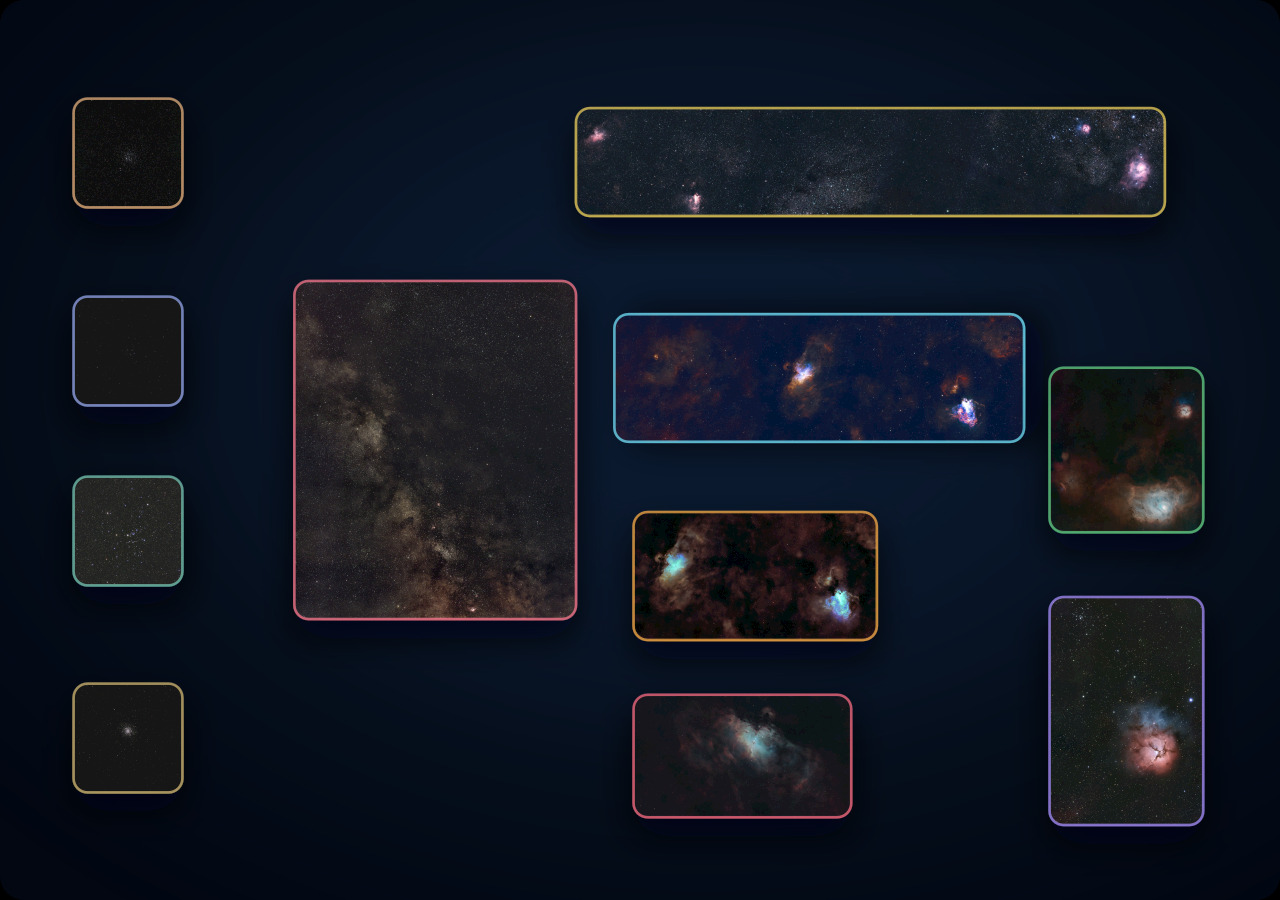
Follow the Milky Way's bright Sagittarius star clouds into linked stellar nurseries around the Lagoon, Trifid, Eagle, and Swan nebulae.
11linked images
1root fields
5nested levels
Milky Way · Sagittarius · compact scale mapConfigured from Sagittarius Survey.md
Registered scale map
Travel from sky region to target
10 of 10 transitions registered with WCS
Sagittarius/Serpens Border
M11
A five-minute view of M11 toward the Scutum side of the field.
Sagittarius/Serpens Border
M26
A ten-minute view of M26 toward the Scutum side of the field.
Sagittarius/Serpens Border
M25
A 36-minute view of M25 within the wide Sagittarius root.
Sagittarius/Serpens Border
M22
A 41-minute view of M22 in the Sagittarius field.
MilkyWay Sagittarius
Milky Way · Sagittarius
A 5-hour 15-minute wide field through the bright Sagittarius arm and its concentration of nebulae and star clouds.
Sagittarius/Serpens Border
Nest to Lagoon
A June 7 panorama carrying 13.4 hours of accepted integration from the Nest and Eagle through the Swan, star clouds, Trifid, and Lagoon.
Sagittarius/Serpens Border
Nest to Swan
The northern branch of the Sagittarius complex, following the Nest, Eagle, and Swan nebulae.
Sagittarius/Serpens Border
Eagle + Swan
M16 and M17 together in one intermediate field.
Sagittarius/Serpens Border
Eagle Nebula
The latest deep M16 result at the tightest scale in this branch.
Sagittarius/Serpens Border
Lagoon + Trifid
The southern branch tightens around M8, M20, M21, and Webb's Cross.
Sagittarius/Serpens Border
Trifid Nebula + Webb's Cross
A four-hour field isolates M20, M21, and the nearby Webb's Cross asterism.
Looking into the inner Milky Way
The Sagittarius star clouds lie along one of the richest sightlines in the sky, toward the inner Milky Way. Dense foreground dust alternately blocks and reveals immense concentrations of stars, while a chain of H II regions marks active stellar nurseries at different distances. The map moves from that broad galactic context into several of the best-known sites where young clusters illuminate and reshape the gas from which they formed.
Nest, Eagle, and Swan: The northern branch crosses multiple neighboring star-forming regions, including the young cluster around NGC 6604, M16’s Eagle Nebula, and M17’s Swan Nebula. Each contains massive young stars whose ultraviolet radiation ionizes the surrounding hydrogen.
Lagoon and Trifid: M8 is a vast emission nebula with an embedded young cluster and dense dark clouds. M20 combines emission, reflection, and obscuring nebulae, its bright center divided by dust lanes into the three lobes that give the Trifid its name.
M22, M25, M26, and M11: Four additional cluster views branch directly from the left edge of the wide Sagittarius root; all four full image footprints are contained within it.
Open clusters and star clouds: M21 and the Sagittarius star clouds add exposed stellar populations to the nebular sequence, revealing how young clusters and dust-rich nurseries share the same crowded line of sight toward the Galactic center.
As in the Cepheus and Cygnus survey, the nesting represents angular coverage rather than a claim that every object in a shared frame belongs to one physical complex.
 AstroGuide:Portfolio Chris Hollander’s Astrophotography