Regional survey · dust, star formation, and Local Group galaxies
Andromeda, Perseus, and Cassiopeia survey
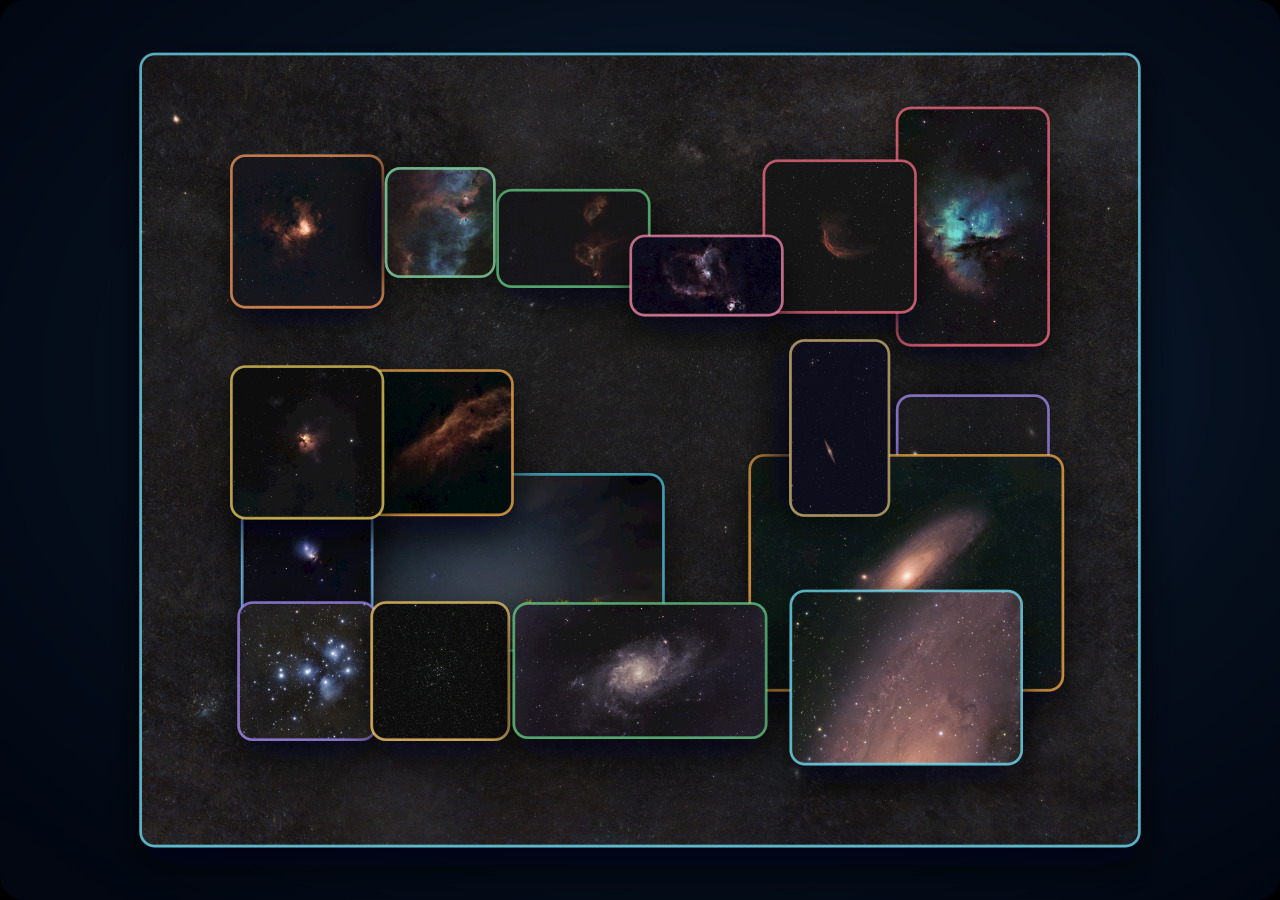
Cross a vast Milky Way-mode panorama from the Andromeda system through Perseus and Cassiopeia, connecting nearby clusters, dark clouds, stellar nurseries, and neighboring galaxies.
18linked images
1root fields
3nested levels
Milky Way · Andromeda, Perseus, and Cassiopeia · compact scale mapConfigured from Andromeda Survey.md
Registered scale map
Travel from sky region to target
17 of 17 transitions registered with WCS · branches mapped around the root
MilkyWay Andromeda Perseus Cassiopeia
Milky Way · Andromeda, Perseus, and Cassiopeia
A seven-hour S30 Pro Milky Way-mode panorama spanning the autumn Milky Way, nearby dust clouds, Cassiopeia's star-forming complexes, and the Local Group beyond.
Andromeda Frame
NGC 147 + NGC 185
Two dwarf elliptical satellites of the Andromeda Galaxy, seen against the foreground stars of Cassiopeia.
Pacman Nebula
NGC 281 · Pacman Nebula
An H II region shaped by the young cluster IC 1590, with dense globules silhouetted against ionized gas.
Heart and Soul
IC 1805 + IC 1848 · Heart and Soul
A broad Cassiopeia field joining two neighboring emission complexes shaped by young clusters and massive stars.
Heart and Soul
IC 1848 · Soul Nebula
A tighter view of the Soul Nebula's ionization fronts, pillars, and embedded young stellar population.
Heart and Soul
IC 1805 · Heart Nebula
A tighter view of the Heart Nebula and the young Melotte 15 cluster sculpting its central cavity.
Andromeda Region Bortle3
Milky Way · Andromeda and Triangulum window
A single 30-second iPhone 17 Pro Max exposure from a Bortle 3 site links the wider autumn Milky Way field to nearby clusters and the deeper M31 and M33 results.
Pleiades
M45 · Pleiades
A nearby open cluster whose bright blue stars illuminate sheets of interstellar dust along the line of sight.
Spiral Cluster
M34 · Spiral Cluster
A loose open cluster in Perseus, made of stars that formed together from the same molecular cloud.
Triangulum Galaxy
M33 · Triangulum Galaxy
A smaller Local Group spiral whose face-on disk reveals knots of active star formation.
Andromeda Frame
M31 · M32 · M110
A 25-hour view of the Andromeda Galaxy and its prominent satellite galaxies, M32 and M110.
Andromeda Frame
AT 2026aabo · nova detail
A registered post-event detail showing the nova within M31's outer disk.
NGC1333
NGC 1333
A reflection nebula and active low-mass star-forming region embedded in the Perseus molecular cloud.
Fossil Footprint Nebula
NGC 1491 · Fossil Footprint Nebula
An H II region and bright-rimmed cloud complex in Perseus, shaped by radiation and winds from a massive young star.
California Nebula
NGC 1499 · California Nebula
A large H II region whose glow is driven primarily by the hot runaway star Xi Persei.
Firefox Nebula
SH2-188 · Firefox Nebula
An asymmetric planetary nebula whose bright arc is shaped by interaction between the expanding shell and the surrounding interstellar medium.
Silver Sliver Galaxy
NGC 891 · Sliver Surfer Galaxy
A four-hour view of NGC 891, seen edge-on through the wide autumn field.
Northern Trifid Nebula
NGC 1579 · Northern Trifid
A compact reflection and emission nebula illuminated within a dusty Perseus star-forming cloud.
Across the autumn Milky Way and beyond
This expanded panorama crosses several layers of the autumn sky at once. Dusty molecular clouds and young clusters in Taurus and Perseus sit in the Milky Way foreground. Farther north, Cassiopeia is crowded with ionized nebulae and recent star formation. Beyond all of them, the galaxies of the Andromeda subgroup and M33 appear through the same line of sight. The nested views turn one broad field into a map of radically different physical scales and distances.
Local Group galaxies: M31, M32, M110, NGC 147, and NGC 185 belong to the Andromeda system, while M33 is another major Local Group spiral. They share the map but lie millions of light-years beyond every Milky Way nebula and cluster in the foreground.
Cassiopeia star formation: The Heart, Soul, and Pacman nebulae trace separate ionized regions where young massive stars illuminate and erode their natal clouds.
A stellar endpoint: SH2-188 is a planetary nebula rather than a star-forming cloud. Its strongly one-sided shell records the motion and interaction of an aging star’s ejecta with the surrounding interstellar medium.
Perseus molecular clouds: NGC 1333 and NGC 1579 reveal reflection nebulosity, embedded stars, and active stellar birth inside dusty clouds. The California Nebula is a much larger ionized structure projected into the same broad neighborhood.
Nearby open clusters: The Pleiades and M34 are populations of stars born together in the Milky Way, but they differ markedly in age, concentration, and their relationship to surrounding dust.
 AstroGuide:Portfolio Chris Hollander’s Astrophotography